Let’s bridge the gap: Empowering Māori and Pasifika in New Zealand’s Trades Sector

“You can’t get a job without experience. But you can’t get experience without a job.”

This is the paradox too many Māori and Pasifika trades trainees face. Systemic barriers stand between them and meaningful, stable careers. The same issues are constraining our businesses, industries and nation.

Skills shortages in the trades are well-documented and persistent, especially in new construction, along with the mechanical, infrastructure and electrical fields. The same problem exists in hospitality, advanced manufacturing and primary sector industries, particularly in Tāmaki Makaurau Auckland. Sam Sefuiva, Mana Whakapai for Māori and Pasifika Trades Training (MPTT) says that without urgent and coordinated attention, this issue will plague our future. 

Sefuiva spent more than a decade as the country’s principal adviser for race relations and is a board commissioner for the Tertiary Education Commission. It’s a space he understands deeply. 

“The unmet skills demand isn’t for beginners. It’s for fully qualified and experienced workers. And that’s the problem: how do we expect a new generation to fill those gaps if we don’t give them a real chance to gain experience?” 


Each year, hundreds of rangatahi complete pre-trade programmes. Many gain support from initiatives like Māori and Pasifika Trades Training (MPTT). MPTT learners are motivated and dedicated. They’ve shown up, studied, passed, and proven they’re ready for the next step.

Yet at the next step, finding an apprenticeship, many are left waiting. And the result? Some end up in unrelated jobs. Others shift into unskilled labour. A few drop out altogether.


Our pipeline is leaking headline over image of pipeline with water pouring out.

Our pipeline
is leaking

Workforce forecasts show construction and infrastructure projects will require a peak workforce of over 590,000 by the end of 2026. That’s almost twice as many workers as we have right now. In fact, it’s the entire population of South Auckland.  Frustratingly, the talent is there to be unlocked, we just need to open the door

We’re doing the work to train the right people. However, our Māori and Pasifika pre-trades graduates need to find the apprenticeships that allow them to become qualified tradespeople. If we don’t connect the start to the finish, we’ll always be playing catch-up.

“When I sit with our MPTT tauira and hear their stories, I know they have what’s needed for the mahi. But the road from classroom to site is too long on their own. We need more partners opening doors.

“Every employer who gives our rangatahi a real go helps us all move forward,” comments Sefuiva.

Industry leaders and researchers recognise Māori and Pasifika as a key solution; these communities are a vast untapped resource.

Māori and Pasifika populations together are already a quarter of the country’s working-age population, and by 2043 will be around 30% of New Zealand workers.

Unlocking the potential among Māori and Pasifika benefits all Aotearoa. As the rest of Aotearoa ages, these young, growing populations are crucial to sustaining our future workforce, rate and tax bases. 


MPTT exists to support Māori and Pasifika into trades careers that are high-value and high-need.

Tāmaki Makaurau Auckland is home to the largest Māori and Pasifika population in the Southern Hemisphere, with a young and growing workforce that holds immense potential for economic uplift. These communities have been disproportionately underemployed, even as trade industries face a shortage of skilled workers.

MPTT is on a mission to bridge this gap, creating opportunity for communities while meeting our region’s workforce needs. We’re connecting people with training and preparing them to successfully transition into sustainable employment.

MPTT Auckland is the largest of 14 national consortia networks. We represent vocational education providers, both public and private, key industries across 15 trade sectors, and Māori and Pasifika communities. Our purpose is to create long-lasting social and economic transformation by building Māori and Pasifika leadership through careers in the skilled trades.

We provide wraparound support: culturally-focused mentoring, scholarships, and transition-to-employment guidance. In a system once designed without a cultural perspective, this has been a game-changer. At last, our learners can see faces like their own and learn from trainers who understand their worlds. It has revolutionised a training sector that did not cater well for Māori and Pasifika, so it logically saw poor outcomes for them. We work with employers to deliver what they’re looking for. 

Cecelia Tuala, Programme Delivery Lead at Downer New Zealand, notes that MPTT’s focus on work readiness benefits employers, which is why they continue to seek MPTT graduates.  

“Downer looks for employees who have a strong focus on health and safety, technical skills, and professionalism. Big projects mean a big focus on managing risk and keeping people safe. Health and safety are huge for us.  But the biggest thing is attitude, how you turn up every day within our business.” 


Building a talent pipeline is not a quick win; neither is building trades careers. The pre-trade training takes a year. Gaining a full qualification can take another three to five years, depending on the employer, trade, and contract.

During that time, government support mechanisms can change. Initiatives like Fees Free, the Targeted Training and Apprenticeship Fund (TTAF), and Apprenticeship Boost have all been introduced – and then altered, reduced, or phased out.

For learners, this means uncertainty. For employers, it makes it harder to commit. This inconsistency works against a strong, sustainable supply of talent. 


Despite the challenges, MPTT and many of our partners brought visibility to the benefits of a trades career. Interest is up and enrolments are rising. Yet, New Zealand’s overall apprenticeship completion rates remain low compared to other similar countries. This is the pinch point, and it’s hurting us all.

We need employers to be supported to train, mentor, and hire so our young people can gain the experience they need to become qualified, securing futures for their whānau and our industries. 

The employers who step up will be the first to benefit. The greater strength of diversity in your team is well-known; it boosts resilience, problem-solving and efficiency. Furthermore, MPTT graduates come highly recommended by our industry-experienced Navigators who know them well. Graduates are ready with tools, safety certifications and clear expectations about punctuality and work ethic.


We know that most construction businesses in New Zealand are small and run lean. When the market contracts, it’s the unqualified workers and apprentices who are first to go. When it rebounds, employers tend to stick with short-term labour hires rather than commit to long-term training.

The consequences are delayed projects and ballooning costs and reliance on transient or migrant labour. Tinkering with immigration laws doesn’t do anything to build a strong skills pipeline or create an environment that retains our best performers. Instead, these things continue to perpetuate the situation, keeping us in a skills deficit.

All the while, sitting on the sidelines are young Māori and Pasifika with the potential to be our next generation of trades leaders. The irony is startling.   


We need systemic change – and shared commitment. The recent ConCOVE report (Construction & Infrastructure Centre of Vocational Excellence) made it clear: our current approach is fragmented, short-term, and doesn’t prioritise completion. These are all things we can address if we work together and start now. We’re not purporting to have all the answers, but we know the strength of an industry pulling together. 

We need secure, bipartisan support for apprenticeship incentives that outlast election cycles.

“We’ve seen this cycle before. Look at the original Māori Trades Training Scheme. When political priorities shift, programmes get cut or restructured, and we lose the institutional knowledge and relationships that took years to build. Our employers remember that uncertainty, and it makes them hesitant to invest deeply in training pathways,” says Sefuiva. 

Larger firms working on long-term infrastructure projects are uniquely positioned to lead. They should be incentivised to take on apprentices and invest in training — and many are.

At Ventia, their size is their strength when it comes to growing talent. The company is big enough to hire groups of new ‘tradies’ together.

“Most MPTT candidates come to Ventia as a cohort. They learn and grow together, and they have peers who understand where they’re at,” says Ricky Steedman, Kaitohutohu Māori and Strategic Relationships Manager.

“If you start out with Ventia, you’ll have the opportunity to go through a whole range of industries and roles if you want to. For example, you could start in transport, go into a team lead role and transition across to other management positions in other sectors.” 

The best outcomes come from partnerships when employers, educators, and support providers work together with aligned expectations and accountability.

“We also need to fund small employers in ways that make taking on apprentices a viable and supported option rather than a risk. New Zealand’s construction sector is overwhelmingly made up of small firms — 97%, and most apprenticeship opportunities inevitably sit with them.

“Targeted support can turn that from a risk into a viable, well-supported pathway,” says Sefuiva. 

Consistent investment and support for Maori and Pasifika ownership and vocational education providers, employers and others involved in the VET system is vital. A Maori and Pasifika “centric” approach not only works for everyone, it is the best way to ensure no-one is left behind. 

Much of our system incentivises participation. But what good is an entry without a finish line?  Apprenticeship completion rates in Aotearoa range from 39% to 58%. We’re far behind countries like Germany and Ireland, where the rates range from 65% to 75%. This needs to change. 

Let’s not overlook who is most affected by the ‘leaky pipe’ of apprenticeships. The systemic issues impact all learners, but they fall heaviest on Māori and Pasifika youth who are statistically more likely to face financial hardship, live in multigenerational households, and need to earn while they learn. That doesn’t mean they’re less capable. But it does mean they need a system that meets them where they are.

We must value completion as much as enrolment — and provide support, pastoral care, and employer training that reflects that.

Sefuiva explains, “Completing an apprenticeship creates lasting benefits for both the trainee and the industry. With those qualifications comes endorsement of their skills and real pride. It gives them options for their future and something to build on.

“From the industry perspective, every apprentice who completes brings fresh capability to the workforce. Apprenticeship opportunities support ongoing business success and help safeguard the future of trades in our communities. They help us make sure there are enough skilled people for our future.” 


Who is responsible? Is it the government’s job? Employers? Industry bodies? The answer is all of us. But who will take the lead?

Sefuiva says, “We’re doing our part. But a young person’s future can’t depend on timing the economic cycle right. If we want to grow a skilled workforce, we need to grow it purposefully.”


As employers, for Aotearoa New Zealand, and certainly for Māori and Pasifika rangatahi, we need to stop thinking short-term. Now is the time to start building the workforce we want in five, ten, and twenty years. At MPTT, we think this means working together across government, training, and industry to build clear, connected, and culturally responsive pathways. A collaborative pathway has already proven its worth in getting people interested and trained for the trades. Now let’s talk about getting them working.  

If you’re an employer, policymaker, or part of the vocational education system, let’s talk.

Is your organisation facing these challenges? Have you found solutions that are working?

It’s time to build a system that delivers for everyone — industry, employers, and our future Māori and Pasifika tradespeople.


Ready to work

Eseta, Jazlin, Jonah and Loma are real MPTT graduates whose futures are on hold, not for lack of motivation, but because the next step — the apprenticeship — remains out of reach. We’re sharing their stories to show the human face of the issues we’ve discussed. If you’re an employer, you could be the one to unlock that potential.

Eseta Lafaele is known for being one of the most engaged students in her cohort while studying Level 3 Construction – Carpentry at MIT.  She’s taken every opportunity to connect with the industry and build her work readiness skills. Although she has worked as an assistant accountant for several years, she loves working with her hands and is passionate about becoming a licensed builder.

Skills:

  • Safe work practices and meeting compliance requirements
  • Effective communications with colleagues and customers
  • Specs and drawings for construction projects
  • Simple calculations for construction work
  • Understanding of basic building materials and technology
  • Carpentry and building construction, and installation processes and techniques
  • Delivering work in a project environment

Eseta says constant knockbacks are disheartening, but she maintains her motivation. “I’m now doing the level four qualification, and I’m also doing a lot of carpentry work at home to practise my skills.

“Most ads are looking for people with experience. But we all have to start from the very bottom and work our way up. If an employer can give someone like me the opportunity to learn, we will grow and be able to offer so much.”


Jonah Leota is a Level 3 Construction Carpentry graduate who stands out as a dedicated worker and genuine leader.
While completing his pre-trades training at NZMA, he was elected to be Class Rep by his peers. He also led his class project team with a humble and inclusive approach. He’s eager to take any learning opportunity and takes the initiative to grow or look for opportunities. His attendance was consistent, and tutors found he’d often go out of his way to help them.

The results he’s gained in the classroom and with practical skills show his attitude and industriousness have paid off.

In looking for an apprenticeship, Jonah has brought the same effort and focus. He keeps in touch with tutors about any building roles and also seeks feedback and improvements for his CV. In October 2024, his course finished. He went door-knocking and applied for many apprenticeship roles. He’s found some labouring work from time to time, but his dream of being a builder is gradually fading.  

Skills:

  • Communication and timekeeping
  • Reading project specs and plans
  • Basic building calculations
  • Core construction skills
  • Best practice health and safety

Jazlin Bing is highly qualified and capable. Her employer will be delighted to snap her up; she just needs a shot. Jazlin has pre-trade training in both Automotive Engineering and Mechanical Engineering. She wants to become a mechanic and work on light vehicles, bringing a unique breadth of skills.

Skills:

  • Knowledge of compliance and regulation
  • Engine maintenance and driveline systems
  • Operation and minor repairs on electric and electronic vehicle systems
  • Maintenance of steering, suspension and brakes
  • Steel, stainless steel and aluminium welding
  • Steel cutting, forming and pipe bending
  • Operation of industrial-sized lathes, milling machines and drilling machines

​​As her studies near their end, Jazlin has been door-knocking and applying online for an apprenticeship role – she’s applied for more than 50 jobs.

“Almost all my friends are in very similar positions. The only person I know who has found a job was through pure luck; she went door-knocking and chanced upon a place that was going to advertise the next day. I just need my chance to prove myself.”


Apisaloma (Loma) Henry is an engaged and eager learner who’s quick to pick up new skills. His pre-trade training in Level 3 Electrical Engineering has revealed his strong practical aptitude.

In October, he’ll graduate from NZMA. However, he’s already work-ready with a solid work history behind him. Apisaloma worked for years in printing, but has gathered experience in labouring that has included everything from asbestos removal and demolition work to scaffolding.

He’ll be an asset to the team he joins. He’s never afraid to ask questions and keeps an eye out for where his help is needed.

Apisaloma has the maturity of a new father, and he takes his responsibilities seriously. He’s driven to support his family and start saving for a house by building his electrical career. So far, he’s spent plenty of time cold-calling and applying for apprentice roles.

Skills:

  • Basic electrical theory and trade practice.
  • Workplace safety
  • Knowledge of NZ electricity supply.
  • Basic practical skills required by electricians.
  • Drawing and interpreting electrical diagrams.
  • Knowledge of switchboards and electric motors
  • Installation of cables and electrical equipment
  • Electrical Testing and diagnosis

Welcoming Lifeskills: Expanding trades training opportunities for Māori and Pasifika

MPTT is pleased to welcome Lifeskills to the whānau, offering practical training in Automotive and Electrical pre-trades, and soon Carpentry Level 3.

“We’re really pleased to have Lifeskills on board as one of our MPTT training providers,” says Sam Sefuiva, MPTT Project Manager.

“With campuses in Papakura, Māngere and Henderson, Lifeskills are helping us cover more of Auckland, especially in high-demand trades like Automotive, Construction and Electrical—areas where we haven’t had enough coverage.”

“It means more options for our Māori and Pasifika whānau, both in terms of where they can study and what kind of environment they’ll be learning in.”

Manu Palelei, General Manager – Growth, Funding and Partnerships, says Lifeskills is looking forward to helping more learners.

“We have a strong track record of supporting those who have been underserved by mainstream education,” she says.


Lifeskills hands-on, values-based courses prepare ākonga for real work in the trades.

“What’s unique about us is that we’ve got all our teaching staff come from the industries that they are teaching, they’re subject matter experts. And not only that, they come from the communities that they’re teaching in,” says Manu.

“We identified that a lot of our learners are Māori and Pasifika young people, as well as second-chance learners. Many were underserved by mainstream education. They felt unseen in the current education space and so have already disengaged by the time they come through to us.”

Lifeskills supports its learners with wrap-around pastoral care. Additionally, small class sizes, individual attention, and a safe, welcoming environment are central to their model.

“We embed tikanga and the Pasifika Way, within the delivery and the content itself. We also have a kaitiaki on campus.”


Lifeskills was formerly known as SkillsUpdate. In 2019, it was purchased by Life Community Trust and later merged with Quality Education Services (QES), bringing together strengths in education and social services.

Lifeskills delivers Level 3 certificates in Automotive Engineering, Electrical Engineering (Pre-Trade), and Construction Trade Skills (Carpentry).

Sam says, “Their foundation-level training is solid, and it sets learners up well to step into our MPTT Level 3 programmes. They’ve got good relationships with local schools—especially ones with large numbers of Māori and Pasifika students—and they’re helping those young people make the move into trades training.”

Lifeskills also works closely with faith-based communities, which gives us greater reach into those spaces and helps connect more people to the opportunities MPTT can offer.

“Their leadership has strong Māori and Pacific representation, and their values line up well with ours. ” says Sam.

Josh Levi, Community Relationship Manager for youth onsite with a group of MPTT automotive trainees at their Henderson campus. There are currently 26 MPTT trainees studying Automotive at Lifeskills across all of their campuses.


Manu Palulei says Lifeskills shares MPTT’s vision of seeing more Māori and Pasifika get started in a trade and lift their earning potential.

“We don’t turn anyone away. For us, it’s about creating a safe place on campus to learn. For way too long, Māori and Pasifika have been on the wrong side of the statistics. In my view, it’s important we define our own success stories.” 

“I think of one student from a very hard background. One day, on his way to campus, he was caught up in a fight and managed to escape. We wrapped around him, and now he’s completed his qualification. In fact, he’s back on campus wanting to do the next level.”

This story shows more than success for that one tauira, but also for their family, peers and the community. Lifeskills is helping our people change the direction of their lives and inspire others to do the same. 


There is high demand for trades covered by Lifeskills. The partnership with MPTT brings more opportunities for tauira and whānau.

Manu explains, “Working with MPTT is the cherry on top of the cake. It’s helping remove barriers for the Pacific and Māori students.

Sam agrees, “I’m looking forward to working with Lifeskills and want to give a warm welcome to their first group of ākonga, tutors and staff.”


Sui’s set to qualify as a heavy hitter in Heavy Automotive

From toying with car sound systems to managing heavy vehicle workshops, Sui’s story shows how qualifications can open doors. His journey proves that with perseverance and purpose Māori and Pasifika tradies can build successful careers. Sui’s roots in Tonga and the Cook Islands, combined with his Auckland upbringing, have shaped his path in the automotive industry.

Sui’s family traces their roots to the Fatai and Kolovai villages of Hihifo in Tonga and Aitutaki in the Cook Islands. Mesuilame Vea-Williams grew up in South Auckland with his sister Alilia and two elder brothers, Isikeli & Kapelieli. His elder brother is the reason for working with cars, but unfortunately, both brothers have passed away. 

“I never planned to work on trucks. Instead, I began working on sound systems in the boys’ cars. My older brother Kapelieli was the mastermind and my teacher then.  I was ordered to do whatever he said when we were working on the cars, and, as little brothers do, I did exactly that.

“I enjoyed what I was doing and began to gain an understanding of how things worked. It sparked my interest in mechanics, especially cars, so I started pre-trades at MIT, studying light automotive with the support of MPTT.”

A chance job during a Christmas break in 2017 led Sui to try working with heavy vehicles. “I came across a trades assistant role at Waste Management. Although I knew nothing about trucks, I thought I’d jump in and try it out,” he says. And it was the right move!

“It was a big company and most of their guys are qualified. However, after I’d been there a few months, I asked them about an apprenticeship.”


Sui pushed hard to get his break. 

“I was constantly asking and bugging them about an apprenticeship, but eventually, they set me up as the first-ever apprentice at Waste Management.”

Since then, Sui took up a new role at JJ Richards in 2018, where then completed his Level 3 and 4 Heavy Automotive qualifications.  

Jodi Franklin from MITO, the industry training organisation, explains that the industry expects technicians to be qualified at level 4. This covers the day-to-day service and diagnostic work in a workshop. 

Sui says one of the differences with heavy vehicles is safety concerns. “Everything is ten times heavier and bigger, so you must develop good safety work processes.” He feels these will transfer over to other types of mechanics.


Sui’s hard work has opened doors. One of the highlights was when he took up an opportunity to be workshop manager down in Tauranga and Hamilton in 2021

“That was one of the best things for my career so far. It gave me the tools and experience to run a business.

“Leadership demands more and different skills around an organisation. In particular, I learned that it saves a lot of time if things are well-prepared and well-organised. Planning takes up more of your time as a leader, but it’s crucial.”


In 2023, a new Level 5 programme was released, and MITO offered Sui an introductory scholarship. Jodi says, “We have been so pleased to see his progress. I am confident he will complete it shortly and join a small group of individuals who have gained the qualification so far.  

“This will really make Sui stand out from the crowd; it is a challenging programme, and he has made great progress. Gaining this qualification shows the industry that he is at the top of his game.

“It’s a step up from the other levels; only a small proportion of qualified technicians enrol in Level 5. Gaining the qualification means you can handle complex diagnostic repairs, oversee team responsibilities and ensure compliance with legislative and company requirements. These skills are an asset to any workshop. And, of course, it boosts his earning potential.”


Sui has big plans for the future. “In five years, I want to be working for myself. I’m already taking steps towards that with my qualifications and starting up a business as a side hustle.

“It is busy fitting everything in because the qualification means you’re looking at complex jobs in a lot of detail. Eventually, I’d like to go beyond heavy vehicles to include cars and motorcycles.”


As a young Pacific Islander, Sui faced challenges working outside Auckland and away from his community. “I was hesitant about being there by myself,” he admits. However, it’s important to him to set an example for other Māori and Pasifika youth thinking about trades.

It’s understandable to want to stick to your own people and language, but you can keep your identity while broadening your opportunities. He says the MPTT programme is special in the way it supports this. “Being clear about my purpose, culture, and identity helped me overcome any barriers”.


Suis advice to others is clear: “Chase your dreams. It doesn’t matter what they are — how big or how small — just go for it. And remember that you’ll never hit a home run unless you swing the bat. Always give thanks to those above you on the ladder for their teachings, but never forget those who have yet to follow your path.”

He stresses the value of qualifications:

“Keep chasing qualifications; your qualification is a ticket you have for life, and you can take it anywhere you go.”

As an industry insider, Jodi agrees. “The automotive industry is constantly evolving with new technologies and systems, so technicians are continually learning and upskilling.  Level 5 qualifications are available in Light Vehicle, Auto Electrical, Heavy Vehicle, Electric Vehicle, and Collision Repair.  

“If you’re interested in the management side, there’s also the NZ Certificate in Business, First Line Management.”

MITO has an annual round of scholarships for Māori, Pasifika, women, and new New Zealanders, and these are open to alumni wanting to look at enrolling into an advanced programme in the New Year. https://www.mito.org.nz/get-qualified/2025-scholarships/

Sui says that being qualified in the industry puts you at a huge advantage.

“There are so many opportunities. Your qualification journey is a gateway to wherever you want to go.”


More stories about a career in Automotive…

Big dreams and big machines
Drive to qualify delivers awesome automotive careers
Fatherhood drives mechanics transformation
From work experience to apprenticeship
Diesel mechanic follows in Dad’s footsteps

Ready to take off? How to secure your first role in a challenging job market

There’s a lot of talk about a tough economy but that doesn’t need to hold you back from finding your start in the trades or levelling up from where you are. With the right knowledge and preparation, you can set yourself up for success. We spoke to the MPTT network to get the inside word on what employers want and where to look. 

Downer NZ Infrastructure employers

The job market is always changing, but there are some key areas where demand for skilled tradespeople is steady. Even in the current economic environment, investment in public transport and urban infrastructure projects continues. Facilities management, maintenance and asset management mean there is ongoing work, too – not all new roles rely on new projects.

Donna Mendjan is Head of Talent Resourcing & Acquisition ANZ at Downer. She says there’s a strong pipeline of work in sectors like transport, utilities, and facilities management. This includes everything from road maintenance and water infrastructure to telecommunications and building services.

“Downer has contracts for government infrastructure projects and utility upgrades, which will need skilled workers like electricians, plumbers, carpenters, and civil engineers, as well as frontline civil crews, including Driver/Operators, Concrete & Asphalt Labourers,” she explains.

“The infrastructure and construction industry is incredibly rewarding. It offers hands-on work that directly shapes our communities. It also builds facilities that improve daily life for countless people.”

At Livingstone Building, James Woodford, Career Development Manager, is also closely monitoring the job market.

“It’s tight out there; I won’t say it’s not. But we are in a solid position, and we’re starting to see things pick up. It’s almost like that bell curve is starting to climb up now.

“A lot more tenders are coming onto the market, although there’s more competition. Two or three years ago, we might have had one other tender against us, but now we have three or four. But we’re fortunate to have a solid pipeline of work.”

Other industries are showing similar trends. Jodi Franklin from MITO talks with a range of employers in the automotive sector. 

“Yes, it is slow out there at the moment, but there are still opportunities for apprentices. They might just need to be a little more persistent and patient for those opportunities to come up.

“The heavy automotive industries always seem to be relatively buoyant – that’s things like road transport, plant and equipment. Even in this environment, there’s a skills shortage. Light vehicle work is more dependent on people’s private spending, so it’s a bit slower.  However, there are over 15 different pathways in automotive trades training – such as collision repair and that always has plenty of opportunities.”

“​​A lot of employers might be thinking, “​​I’ll take on the right person,” but they won’t advertise because they don’t want 100 people applying for their apprenticeship position. They want the right person to walk through their door.”


Understanding the different tiers of employers can help you tailor your approach when job hunting – they range from Tier 1 employers (like Downer) to small-to-medium enterprises (SMEs).

Tier 1

Tier 1 companies like Downer offer large-scale projects with structured processes. Cecilia Tuala from Downer says, “We’re a business of 10,000 in New Zealand – right across the country. We service many Defence Force sites, and we’re proud to be one of eight companies involved in the City Rail Link.

Downer looks for employees who have a strong focus on health and safety, technical skills, and professionalism.

“Big projects mean a big focus on managing risk and keeping people safe. “Health and safety is huge for us. It’s important that our people get to return home. At Downer, a driver’s license is an advantage, especially if you’ve got your full license and can drive a manual vehicle. But the biggest thing is attitude, how you turn up every day within our business.”

Tier 2

Livingstone Building is a Tier 2 Commercial Construction company. James says this means anything from large-scale commercial buildings and warehouses to schools and recreational facilities. We also have an asset management branch, which completes smaller jobs such as maintenance and facilities management. They work with subcontractors and have strong relationships with training organisations and MPTT.

“At Livingstone, we make connections to support people in going where they want to go,” explains James.

“We believe that if we invest in the people, they’ll invest back in the company. We’re quite fortunate to have some very long-standing carpenters who are on that pathway. We try to keep around 35 to 40 apprentices so that we can grow them. Our retention rate has been really good.”

SMEs

At the other end of the scale are SMEs – Small to Medium Enterprises. They may offer more flexibility but still expect the basics, such as a driver’s licence and good work ethic. 

According to David Parsons from BCITO, SMEs often look for apprentices who are eager to learn on the job and can adapt quickly to different tasks. When you have a smaller crew, you may get exposure to a wider range of jobs and responsibilities.

The automotive sector also has a range of employer types, according to Jodi.

“If we’re just talking about working on cars, there are those small, one-man bands, garages that might just have a couple of staff. Those are the sort of workshops that do all of the work on all the different brands of cars. It means a wide range and a good grounding in different aspects of the industry. 

“On the other hand, there are big brand franchises such as Toyota, Mitsubishi or Porsche. Their work focuses on one particular brand of vehicle so you can build your expertise on them.” 

Stepping up can impress employers of all sizes, she says. 

“I hear this all the time from employers: they really pay attention to the individual who has the confidence to come in, present themselves, and bring in a CV. 

“If you show that you’d love to work there, it shows how interested you are in getting into the industry. Everyone knows it takes guts to approach people like that. What the employer sees then is your communication skills, how you present yourself, and your enthusiasm for entering the industry. That’s always the number one way to get noticed.”


Certain trades have peak hiring seasons. For example, construction tends to ramp up in the warmer months when outdoor work is easier. If you’re aiming to secure an apprenticeship soon, now is the time to start preparing. MPTT has plenty of resources to up your work-readiness, and they’ve been set up to meet employers’ needs. Being prepared and having personal skills is a priority, and your technical skills will be built over time. 

Make sure your CV is up-to-date and that you’ve added the qualifications you can, like a driver’s licence. Reach out to potential employers early so they know you’re keen.


The Apprenticeship Boost programme provides funding to employers who take on apprentices. This means that if an employer hires you as an apprentice, they could receive financial support from the government — making it easier for them to bring you on board.

If you’re talking to potential employers, don’t be afraid to ask if they know about this programme. It could be the extra motivation they need to sign you up! 


Employers want more than just technical skills—they’re looking for people who are reliable, safety-conscious, and ready to learn. As Cecilia Tuala  mentioned, having a full driver’s licence is often seen as being “halfway there“ when it comes to getting hired.

But it’s not just about licences. Your attitude matters just as much. Employers want people who show up on time, listen well to instructions, and take health and safety seriously—especially in high-risk industries like construction.


MPTT is all about supporting Māori and Pasifika to succeed and lead in the trades. Employers that share our values help create an environment where you can thrive.

We’re happy to support mahi that is going on with MPTT, says James. “We are trying to invest in our youth, invest in our apprentices because they are the carpenters of the future.”

Livingstone Building is also very supportive of wāhine in trades, having had some amazing women apprentices. 


Jodi Franklin with MPTT students

Good news! If you’ve completed pre-trades training through MPTT, you’re not starting from scratch—you’ve already laid a strong foundation.

Make sure you highlight these skills when talking to potential employers. They’ll appreciate knowing that you’ve already got some practical experience under your belt.

Jodi Franklin explains that it’s never too early to start. 

“If you can do work experience while you’re at polytech doing Level 3, that’s invaluable. You might be offered an opportunity at the end of your programme or even during it.”

“It’s a chance to make a good impression and have someone from the industry who can vouch for you to another employer. They’ll know someone who’s looking for an apprentice or will give you a great reference. If you can fit work experience into your schedule, it can be a real game-changer. “


The job market might be competitive, but by understanding where the work is and what employers want, you can give yourself a head start. Whether it’s getting your driver’s licence sorted or brushing up on health and safety practices, every step counts towards securing your future in the trades.

Now’s the time to reach out to potential employers—whether they’re Tier 1 giants like Downer or local SMEs—and show them that you’re ready to work hard and learn fast.

And finally, make the most of your MPTT scholarship by staying in touch with your MPTT navigator. They often hear about opportunities early or are asked to make recommendations.

Award winners share their advice on succeeding in Pre-Trades

Each year, among the hardworking MPTT scholars, we recognise the most outstanding learner in each trade’s pre-training course. As they received their awards, they were full of encouragement for others.

According to his tutors in Electrical pre-trades, Electrical D’Troit Leef-Hema is a born leader and tino pukumahi (very hard-working) young man, with an awesome attitude and is always willing to help anyone who needs support, be it in their studies or just in general. He says, “Don’t be afraid to take a risk and put your name out there.”


Chloe Tupou received the Outstanding MPTT Women in Trades Award for 2023

The nominees and winners of the Outstanding Graduate Awards all worked hard in their courses. Chloe Tupou advises, “Listen in class and take down every detail and every bit of information you can get into your head.”

Her tutor explained, “Chloe had a goal to succeed, and she did.  She contributed in all classes, showed good automotive skills, outstanding paperwork, great attitude, attendance and communication. 

As a result of her attitude, Chloe has already secured a job in the automotive industry. She says, “In five years, it’s a big ask, but I’d like to open up my own workshop and become my own boss. I’m very into my boy racer vehicles, but if not those old Mustangs.”


Nadia Ruke was the winner of the Outstanding Hairdressing Graduate. Her tutor, Vicky Grant, says her award was definitely well deserved. “her attendance and her completion of work were to a very high standard. She’s a great team player.” 

Nadia is already in full-time work. She’s looking towards a future travelling the world and focusing on avant-garde hair styling. She says, “Advice I’d give to others starting this journey is to stop stressing – that’s the big one. It’s about taking things one step at a time and prioritising well.


All the students nominated for our 2023 Outstanding Graduate awards have set a fantastic example and all deserved to win. Congratulations to all of them — thank you for inspiring others. 

The nominees for Outstanding MPTT Trainee were (winners in bold):

Automotive:  Fred Tollemache (MIT), and Shakyro Marsters (Unitec)

Construction: William Saulala (NZMA), Harris Laulu (OCA), Eliu Fui (Unitec) and Hale Faiumu (MIT)

MPTT Construction Award nominees

Electrical: D’Troit Leef-Hema (MIT) and Anaru Carroll (Unitec)

Hairdressing: Nadia Ruke (MIT) and Jamiee Tito (MIT)

Hospitality: Felecity Bray (MIT)

Mechanical Engineering: Bobbi Pouesi (Unitec)

Plumbing, Gasfitting & Drainlaying: Stormy Cruze Reihana (MIT) and Hafoka Losaki (NZMA)

Refrigeration & Air Conditioning: Krishal Singh (MIT)

Women in Trades: Chloe Tupou (MIT Automotive), Jamiee Tito (MIT Hairdressing) and Alilia Vaka (MIT Mechanical Engineering)

Big dreams and big machines

Justus Paitai, Heavy Automotive Engineering Apprentice
MPTT scholar Justus Paitai is doing what he loves by working on all types of large machinery – including diggers, dump trucks, loaders and “basically anything you see on the side of the road where there is dirt and big machines”.
Justus Paitai, Heavy Automotive Engineering Apprentice

He studied at Manukau Institute of Technology and then signed up for a heavy diesel course. Now, he’s almost finished his apprenticeship, a New Zealand Certificate in Heavy Automotive Engineering – Plant and Equipment (Level 4).

“When I first started at MIT, I got in touch with MPTT. They helped get me through the schooling, and after I signed up for a heavy diesel course, they offered me $1,000 to help cover the cost of tools once I started in my workplace – as an apprentice, that was very, very helpful.

“What I like most about my apprenticeship is always learning something new – and being able to apply that the next time I go out. It’s good to know that everything I have learn’t is sinking in, and I am able to use it.”

Read more in School Leavers magazine.

Could this be your future? You can find out more about career opportunities in Automotive on our website. A scholarship from Maori and Pasifika Trades Training will help overcome any financial barriers and allow you to and save your ‘Fees Free’ for your apprenticeship fees.

David Parsons – MPTT Kaitohutohu Ahumahi

David Parsons — MPTT Kaitohutohu Ahumahi
David Parsons is of Ngāpuhi decent, his marae is Taheke, he whakapapa’s to the Pou whānau. At MPTT he is our Kaitohutohu Ahumahi.
David has almost 20 years of experience with the BCITO (Building and Construction Training Organisation) helping people navigate the trades. He is delighted to join the MPTT project team so that he can give back to the sector he loves and help support Māori and Pasifika into trades.

David’s role is as an industry connector. He’ll be supporting tauira, providers, and employers to ensure strong, smooth progressions from pre-trades training to apprenticeships and beyond. 

He’ll help MPTT tauira take their next step once they have completed their pre-trade course with their navigators who together will help them find employment and an apprenticeship.

His long experience in the industry means he’s seen how much success spreads when trainees commit to the trades.

“Those who stay the distance to get qualified become sought after successful employers who inspire others to join the trades. This tuakana teina relationship is special to Māori and Pasifika and is immensely powerful.”

David acknowledges that it can be a challenge to persevere and get qualified, but he says the long-term gains are worth it.

David is here to help anyone who wants support seeing their apprenticeship or apprentice all the way through.

David also wants to encourage more Māori to step forward and put themselves out there. By doing so they can receive the support they need to succeed in the trades. “It’s about making things better for Māori and Pasifika,” he says. With David on the team, we’re sure to do more of that than ever.


Beyond apprenticeships

Advancing your career as an MPTT Alumni
Getting qualified in the trades is a path to a secure and satisfying career, and it can also be a stepping stone to even further advancement. Whatever your trade, there are plenty of opportunities once you’ve completed your apprenticeship. Whether it’s getting recognition as a master of your field or learning to supervise and manage, the opportunities are as far-reaching as your imagination.

Once you’re qualified, out working and ready to advance in your industry, you can level up with a Certificate in Business Skills First Line Management. It’s suitable for current or aspiring managers or supervisors in a range of industries, including Automotive, Transport & Logistics, Drilling, Mining & Quarrying and Gas, Hospitality, Engineering, Fabrication and more.

Below, we’ve listed more of the exciting advancement opportunities for taking your career to the next level, becoming a manager or even your own boss.


Big steps to becoming the boss in your trade

Automotive

Jodi Franklin from MITO says completing your apprenticeship is just the beginning. Graduates can go on to specialise in advanced fields of work with qualifications such as Electric Vehicle Level 5 or the new suite of Level 5 automotive programmes in Light, Heavy Vehicle, and automotive Electrical (being released in 2023).  If you’re interested in leadership, the New Zealand Certificate in Business can be a pathway to a management position or increase your skills and knowledge.

“We actually have scholarships advertised now that include Māori and Pasifika categories, so it’s a great time for people to consider what they would like to do next.” 

You can see the list of scholarships here: www.mito.org.nz/get-qualified/2023-scholarships/


Building and Construction

In the construction industry, there are also training opportunities to give you the skills to become a supervisor. 

David Parsons of BCITO says the Level 5 Certificate in Construction Trades — Supervisor recognises your ability to manage people and job sites, tender for new work, decision-making and much more. There are many opportunities to own your own business in construction when you equip yourself with the right knowledge, practical abilities and people skills. 

Licenced Building Practitioner

The Licensed Building Practitioner (LBP) scheme requires building practitioners to be licensed to carry out or supervise work that is critical to the integrity of the building. This kind of ‘restricted building work’ concerns homes and small to medium-sized buildings. Gaining your LBP Licence means you can carry out more complex work, including:

  • active fire safety systems
  • brick & block laying
  • cladding
  • foundations
  • framing
  • roofing.

Being qualified is an important component of getting licensed to practise. To find out more about licensing, refer to Licensed Building Practitioners.


Electrical

Once you have completed your electrical apprenticeship, you can look ahead to the National Certificate in Electrical Engineering (Advanced Trade) L5. This programme is ideal if you’re a registered electrician looking for an advanced qualification to develop your electrical, business and overall leadership skills.

ETCO offers the Master Electricians Competency Course for registration or renewal of a practising licence for electricians, electrical apprentices and electrical workers. It covers updates and changes to electrical legislation, supervising trainees, first aid and much more. Find out more at ETCO.


Hairdressing

Once you’ve completed your hairdressing apprenticeship, advanced cutting and colouring training allows you to take the next step. With the advanced colouring course, you are able to work as an advanced professional hair colourist within a commercial hairdressing salon or as a self-employed stylist in a variety of settings.

Advanced cutting training equips qualified hairdressers to provide specialist cutting services and advanced techniques. These qualifications will set you up for operating with complete self-management when cutting hair. To find out more, visit HITO.


Hospitality

In hospitality, great managers aren’t born; they’re trained on the job. Some of the courses that can help you do this are the Team Lead Savvy Award – Level 3, New Zealand Certificate in Business (Introduction to Team Leadership) and the New Zealand Diploma in Hospitality Management – Level 5. 

Each of these qualifications will help you upskill with the knowledge and capability to be able to manage the premises’ day-to-day operations, staff and planning and pull everything together to provide first-class customer service. Find out more at: www.serviceiq.org.nz/training/management-and-supervision-programmes/


Painting and Decorating

All qualified paint apprentices can apply to attend a sponsored Master’s Course. This will teach you about running a painting business, including costing, measuring, staff management, employment relations and health and safety.

You’ll learn about:

  • present and future trends in the paint industry
  • the role of the architect within the industry
  • industrial relations, employment obligations
  • management of a painting contracting unit
  • colour and its use within the industry.

Gaining experience running small to progressively larger projects within an established company and this learning will help you if you wish to start your own painting business.

Find out more at Master Painters.


Plumbing and Gas fitting

Qualified plumbing apprentices have opportunities to advance their careers with both the First Line Management qualifications and with specific industry training through Master Plumbers. Examples of topics included are Contract Law and Dealing with Consumers.

To become a Master Plumber, you need the highest qualification available and are responsible for making sure the company’s work is done competently. All Master Plumbers members have a certifying tradesperson on the team and undertake quality assurance reviews of their business practices.

Find out more at Master Plumbers.

MPTT Navigators help students reach their destination

Makahn with some of her MPTT students
All MPTT students have the support of an MPTT navigator, which not only sets our programme apart but also sets MPTT students apart when they start work. Our Navigators mentor students every step of the way through their studies so they graduate work-ready and poised to thrive.

We spoke with Navigator Makahn Warren-Chapman to hear more about what MPTT Navigators do. Makahn, who is Samoan, Māori (Ngāti Tūwharetoa, Te Whakatōhea, Te Whānau a Apanui, Ngāi Te Rangi) and Irish, loves what she does. She sees her work as a way to give back to her community in South Auckland, helping people build new futures for themselves.

“In a nutshell, I hold a mentor role for students who are studying to become tradespeople. I’m here to ensure that they’re ready to leave their studies work-ready and they can start their careers,” says Makahn.

“The scope of support that MPTT offers through Navigators like me is quite wide. We’re there for students when they first start their pre-trades training, through to when they graduate, as they seek employment and find a placement in their chosen trade. We give face-to-face support, one on one meetings, and group workshops.”

A major goal of MPTT is to nurture more Māori and Pasifika into leadership positions, and this means setting them up well from the beginning. It includes helping people build confidence and know how to perform at their best.


Navigators walk alongside students

Makahn says she and her team consider the whole journey so they can give the right support at the right time.

“We offer specific support at different times during people’s study. For example, in the first part of the year, we start by getting to know the MPTT ākonga, what their goals are, and how we can make that happen by building individual pathways.”

Navigators support ākonga to identify anything that might stand in the way of their progress so they can help them make a plan to get past any obstacles. This includes things such as getting a driver’s licence and arranging childcare.

“One of the things we have identified is that people might not know how to write an effective CV, so we’ve developed a workshop that can assist with this. We also offer workshops about how to manage job interviews.”


Navigators help find and fix

Navigators are ready to advocate for ākonga in whatever way matters most.

“Sometimes people struggle just to put food on the table. So, we can connect them to food banks or food parcels.” Makahn says she’s also helped students understand what support options they might have for things such as devices.

“There are a few schemes that can help students with devices. We support ākonga to get their application for those and fill them out. We also help push their applications forward. We know that a lot of the time, our Māori and Pasifika students are kind of left on the outskirts and don’t know how to advocate for themselves. So, we do a lot of that.”

There’s one piece of advice she gives to every Māori and Pasifika student.

“Don’t be scared to ask for the support that you need. Some of us can be humble, and we tend to shy away from asking for help. But that help is available. And not only that, but providing support to MPTT students is our whole purpose as Navigators.

Makahn with other members of the MPTT Navigation team at a workshop held on Unitec’s campus

Plenty of pathways to explore

Makahn says an important part of her work is raising awareness of what potential pathways are available. Trades training can unlock a huge range of options.

“There are so many opportunities within the industry for Māori and Pasifika – more than people might realise.

“Some people have the idea that studying trades leads to only specific roles such as becoming a sparky or mechanic, but there are so many different pathways that open up. We work hard to help students gain awareness about all the career options training makes them eligible for.”

When students are ready to start work, the Navigators can help guide them through the process of gaining employment. Navigators act as a link between training institutes, students, and industry so they understand where job opportunities are and can help with placements.

Makahn says it’s important to consider the fit between the trainee and the employer. Navigators look at the culture of the workplace, what kind of support is offered, apprenticeship pathways and much more.

Once there’s a job offer, Navigators can help explain what it means. They can talk through how it might compare and expectations. This can give both ākonga and their whānau reassurance about their direction.

But the support doesn’t stop there. Navigators stay in touch as people settle into their positions, and graduates remain part of the Māori and Pasifika Trades Training community. There’s always useful information, opportunities, development and help on hand.  


Adventure awaits the ambitious

“One of the things I’d like for Māori and Pasifika people to know is that there is just so much out there. If they’re willing to do a little digging to create networks with others and maybe even step out of their comfort zone, they’ll find the opportunities they want.

“As a profession, the trades are evolving so quickly, and there are so many different roles and responsibilities within each area. It’s not an industry that’s stagnant – it’s always growing.”

And that’s why Makahn wants to see more trainees join the MPTT programme, to help them gain a qualification and build a career that will give them a stable and rewarding future.

Fatherhood drives mechanic’s transformation

Kalib Lewis grew up working on cars, and his hands-on skills helped him quickly land an automotive apprenticeship. But he put the theory side of his training on the backburner for a few years – until he found out he had a baby on the way. Find out how the added motivation of fatherhood has led to huge changes in Kalib’s life, from getting qualified and becoming a foreman to buying a home for his whānau.

Growing up in Auckland with parents who did dirt track racing, Kalib knew his way around an engine from a young age.

“I’ve been working on cars since I was in nappies. I was always around speedway and dirt track racing and stuff like that. I was born into it, really.

“My parents knew basic stuff about cars, and they’d just get the job done and make it work. So, sometimes we had no idea what we were doing – we’d just pull it apart, see how it works and put it back together. ”

This practical background served Kalib well when he started officially training in the automotive trade. With a recommendation from his tutor at Manukau Institute of Technology, he quickly landed an apprenticeship (managed by industry training organisation MITO) with Davies Motors in Manukau.

However, the theory side of his apprenticeship was a challenge at first

“It was hard, especially because I was working 45-hour weeks at the time. So I’d go home and think, ‘I don’t really want to do this because I’ve been working on cars all day’. I’ve also got dyslexia, so reading and writing is not really my strong point.”

But after a slow start with his bookwork, Kalib found a powerful source of motivation to get qualified.

“I had a son on the way, so I was like, I need to get qualified. I need a pay rise and I need to get this done.”

“And that was the majority of my motivation in the end, was my son. Just to get my apprenticeship done and out of the way, because I wouldn’t have time later on – like, I’d have to juggle time with my son and being at work.”


Crossing the finish line

With his son turning two in September, Kalib (Ngāpuhi) has now been a qualified mechanic for around a year and is the workshop foreman at Auto Xcellence Ltd in Manukau.

“Getting qualified was a big relief. It was a huge weight off my shoulders. You never realise how much of a weight it puts on you until you actually get qualified.”

Kalib’s whānau are proud of his achievements, both in the trades and on a personal level.

“I’ve changed a lot over the past few years, and they’re stoked with where I’ve ended up. Believe it or not, I used to be a little devil child that used to go out and get in fights and stuff. My son’s sort of calmed me down and helped me realise there’s more to life than just myself.

“I’m a better person for it. Like, you live and you learn, and I know what to look out for now. And when my son came along I realised I wanted to be better for him. Even I’m surprised how much I’ve changed.”


Fuelling change

With his qualification under his belt, Kalib’s higher income helped him and his partner to purchase their first home in Manukau.

“We’re in the final process of signing our house contract. We’re actually building on the back of my partner’s parents’ place. So that’s how we’re getting into the housing market.”

Saving the money for a house didn’t come naturally, but the 23-year-old set his sights on the goal and worked with his partner to do what was needed.

“I was one of those people that lived paycheck to paycheck. I just threw money around and didn’t really care. But with my son coming along, the priorities changed. It’s not all about me now.”

Knuckling down and saving money has allowed the couple to get set up for their future, says Kalib.

“We’ve achieved so much in the last year since I’ve been qualified, it’s ridiculous. But most of that comes down to, honestly, working long hours and saving money.”

“I took a year off racing and was like, ‘this is the goal we’re saving for’. Once we’re in our own place, I can start racing again.”


New direction

Having finished his apprenticeship, Kalib is now part of a small team at Auto Xcellence, where he’s learning how a business is run and how to work with customers.

“When my boss is away, I run the place. It’s sort of the next step. And then probably after that, the next step for me will be starting my own business. That’s a five-year goal.

“For me to own my own business one day, I have to see how a small business runs. It’s a big change from being in a corporation where you’re not dealing with customers regularly. My job now is more of a family environment. You get to know the customer on a more personal level rather than, oh, we’re just servicing your car.”

Part of Kalib’s role has been learning how to invoice customers, which often involves working within what the customer can afford.

“Being in a low socio-economic area, It’s been a big eye-opener. The customers can’t always afford for everything to be done. So, it’s being able to work with the customer as well.”

Success in the automotive trade takes dedication and patience, says Kalib.

“You have to enjoy what you’re doing and be dedicated to it. I’m big on enjoying what you’re doing, otherwise don’t do it at all. Don’t just half-arse it; you’ve got to be fully committed to what you’re doing.”

“It’s about learning how to be a mechanic, not a part fitter. Because anyone can be a part fitter, but to be a good mechanic takes some time and some problem solving.

“Often with diagnostic stuff, you’ve got to be patient. You’ve got to follow the systems that are in place or follow whatever the service information says. And you have to be dedicated to be able to find the fault and not give up and put it in the too-hard basket.”

Now that he’s qualified and working as a foreman, Kalib is keen to focus on enjoying life with his whānau while he builds up experience in his trade.

“I just want to live life how it is. I used to be a person who took everything to heart, but I know now that life’s life and you can’t really control it, so you might as well enjoy it while you can.”

Want to work with cars like Kalib? Find out how to train in the automotive trade.

From work experience to apprenticeship

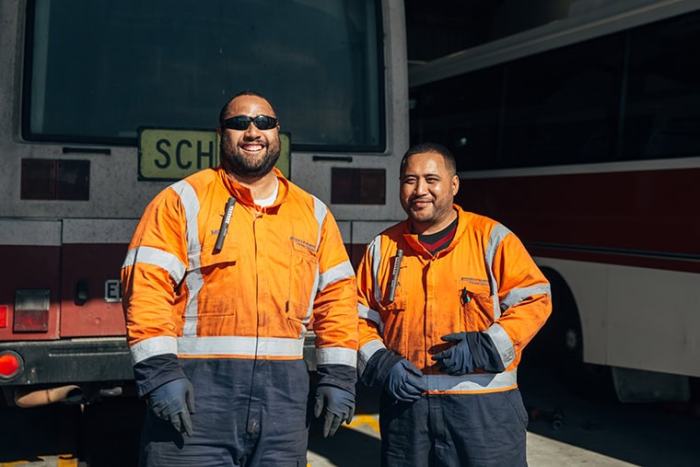
A summer’s work experience in a busy bus workshop has been the key to a brighter future for good mates Kamosi Finau and Puna Taruia. Find out how these automotive trainees turned work experience into apprenticeships – and how you can do it too.

Talking to an employer can be scary, but it’s one of the best ways to get your foot in the door. Just ask Kamosi and Puna, whose introduction to an automotive employer led to a job over summer – and an apprenticeship offer.

The pair showed up for work experience at Ritchies Murphy Transport Solutions in Takanini during their last term of study at Manukau Institute of Technology. Thanks to their hard work and keen attitude, they made an impression on the workshop manager, Dave Robb (pictured with Kamosi and Puna above).

“I brought in half a dozen students for an introduction to a real engineering worksite,” says Dave, who manages four apprentices and 12 senior staff in the workshop and panel shop, maintaining and repairing a fleet of 160 buses and 40 cars.

“Some of the students were a bit cocky and some didn’t seem interested. But these two were writing things down and really taking notice,” says Dave.

“It’s about attitude in this game — you don’t have to know anything, you just have to be really keen to learn.”

Putting yourself forward

Fronting up to an employer is really worth doing, even if you feel scared or whakamā (shy).

“Just knock on the door and offer to sweep the floor,” says Dave. “Work experience gives you an idea of what you want to do and gives you the inside running when a job comes up.”

Although they were lucky enough to meet Dave through the course, Puna says approaching employers for work experience takes courage, “especially if you’re a bit shy like me!”. But putting yourself out there shows the employer you’ll be willing to put in effort on the job.

And once you’re in the door, you can show your enthusiasm by keeping busy, says Kamosi.

“Work experience is your chance to get on board and show you’re keen.”

“You can never stand there with your hands in your pockets. You’ve got to always be watching the tools and the ways of doing things.”

Getting started

work experience landed Puna an apprenticeship

Puna, 29, grew up with a love for cars — fixing and modifying them in the family garage in Mangere. The Taruia family whakapapa to Niue on his mother’s side and Cook Islands on his father’s. Puna has a sister, and two brothers who are qualified tradies.

He’d been working for seven years as a process worker in a food industry factory and, with his family’s support, he decided to “step up to better things and get qualified”. He started with a NZ Certificate in Automotive Engineering (Level 3) at MIT with help from an MPTT scholarship, which is how he met Mosi.

Kamosi is currently doing his apprenticeship in mechanical engineering

Kamosi Finau, 30, is a married father of a 14-year-old son and three girls aged 11, 5 and 2. Mosi was born and raised in Otara and his family come from Tonga, where they usually try to visit every couple of years.

Having been forklift driving and loading trucks at Foodstuffs for 10 years, Kamosi decided to make a change.

“My father-in-law is a mechanic and he was pushing me to think about a career. I didn’t know much about mechanics, but I enrolled at MIT and things just opened up for me.”

A foot in the door

After laying the groundwork with unpaid experience during their last term at MIT, Puna and Mosi applied for paid work experience at Ritchies over the summer holidays.

“We thought we’d give them both a go,” says Dave. “They started off cleaning dirt from the roofs of the buses. And they turned out to be so keen and useful we buddied them up with a mechanic and extended their paid work experience by three weeks.

“Now — and they weren’t expecting this — we’ve just offered them both apprenticeships,” says Dave.

“We were only looking for one apprentice, but they’re both good blokes and they seem to like being here, so we’ve bought them a toolbox each and look forward to having them around.”

work experienceDave says Kamosi (left) and Puna (right) fit in perfectly with a team that works hard and safely, but has a few laughs along the way.

Puna says getting an email from the chief executive, Todd Murphy, was a huge boost.

“It just gave me massive confidence to know I’m in a job with a future, getting great training and learning work practices from the old boys.”

Dave says he’s always keen to meet enthusiastic learners, and encourages trainees to introduce themselves to potential employers.

“I might be a bit old-school and my approach takes a bit of courage, but I reckon if you front up and knock on the door of a place you want to work, you’ll nearly always get listened to.

“People can see your character when you look them in the eye. It’s a whole lot more effective than sitting behind a computer and answering a whole lot of ads. It gets your foot in the door.”

Work experience helps you get your foot in the door and learn heaps about your trade – and many employers won’t hire you without it. Find out more about how to get work experience.


Make your mark

Work experience is essential for building your skills and adds valuable trades experience to your CV. In fact, a lot of employers won’t hire someone who hasn’t done work experience. Check out these tips on how to land this work and make a good impression on your boss.

  • It’s normal to be scared to talk to an employer, but knocking on their door is well worth the effort. It shows initiative and a positive attitude, which is exactly what employers are looking for.
  • To help you feel more confident approaching an employer, do a bit of research by checking out the company’s website and talk to your navigator for advice.
  • When you show up for work experience, bring a small notepad and pen and take notes on what your boss says. This shows you’re keen to be there and will help you remember what you learn.
  • Ask questions. This shows you’re paying attention and want to learn more. Remember, employers don’t expect you to know much when you’re starting out. Instead, they’re looking for enthusiastic workers who value the chance to be there.

Diesel mechanic follows in dad’s footsteps

Joseph at work at home
Automotive apprentice Joseph Kaufusi always knew he wanted to work with vehicles. “I like being on my feet, working with my hands, and getting dirty,” he says. The 24-year-old is gunning to get qualified through MITO – having already managed to smash out more than 90 credits by June this year, compared to the 75 credits expected for the entire year.

We caught up with Joseph to find out how he got into his trade, his goals for the future, and how his dad’s been a big inspiration in his career.

Firstly Joseph, tell us where you grew up?

I grew up in Tonga (Vava’u) until I was eight – that’s when my family moved here to New Zealand. We used to go back to Tonga once a year when I was little, when flights were cheaper and all that. But as I got older, I was going back once every two or three years. 

We lived in St Lukes when we first moved to Auckland. Then we moved out to Mangere and that’s where we’ve been ever since. I’m still living at home, just trying to finish up this apprenticeship. 

I’m from a small family, which is pretty weird for an islander. I’ve only got two siblings and they’re both younger than me. The youngest one’s actually over at Unitec with an MPTT scholarship, doing construction. 

Like father, like son: Joseph and his father Kiva share a passion for working on cars, trucks and heavy machinery. 


How did you get interested in working with vehicles?

I’ve been surrounded by people in the trades all my life. My dad’s a diesel mechanic. He did his main university training in Fiji, and then he came back to the mainland in Tonga and did the rest of his practical training there. 

He started out with the old, hand-cranked diesel engines. By the time I was born, he was already 12 years into his trade. Dad still works on trucks and stuff, but that’s only in his off-time. Now he’s at the testing station doing warrants of fitness and certificates of fitness. 

And has your dad helped you much with your training?

Yeah, I learned a lot of the basics from him. Given that I pretty much grew up around the industry I’m in, and I had some knowledge of diesel engines and cars in general, it was easier for me to progress through the learning. 


I do talk about it with dad quite a lot, especially with my assignments. With bits I don’t understand, I just call up dad and we go through it. 

It’s awesome when I’m doing my own projects, like working on cars at home and all that. If I get stuck I’ll ask dad, ‘What’s the best way of doing this?’ and he’ll come out and show me. 

There’s some new stuff I’ve been able to show him, too, mainly on the electrical side with using the new scanning systems that have come out recently. 

You were awarded an MPTT scholarship — how has that helped you?

It’s been a big help. I had money saved up for my course fees — that was all my savings from doing odd jobs here and there. When I got the MPTT scholarship, that made everything a whole lot easier. There was a load off, not having to think about how I’m going to be paying for all my courses and everything. So, I didn’t have to use up all my savings.

My MPTT navigators Pava and Tu were real helpful too. I went to them for advice on career paths and stuff like that, and they were able to provide me with all the info I needed. 

How did you land your apprenticeship?

It was through MPTT as well. I was about a month out from finishing my course, and MPTT organised a recruiter to come to Unitec for a bunch of job interviews. Within a couple of days, I got a call from the recruiter offering me a job at Hirepool, which was where I started my apprenticeship in 2017. 

I was at Hirepool for almost three years, and last year I moved to Universal Diesel. The main reason I moved was around getting the apprenticeship done. When I started training in heavy diesel, there wasn’t enough work for me to do at Hirepool. So, I had to make the call that was right for me and what I wanted to do in the future. I got on well with my boss at Hirepool, and when I said I needed to leave, he said ‘Go for it’.

How did you find your job at Universal Diesel?

I talked to my dad to see if we had family or any of his mates who were working in the industry. He asked them if the companies they were working for were looking for apprentices. And he came back with the position at Universal Diesel, because one of our relatives is the workshop foreman. 

Working in heavy diesel was a deliberate choice for me. If you’re a diesel mechanic, you have a lot of options because you’ve done your training on anything from trucks, buses, all the heavy equipment, all the way down to cars and lawnmowers and stuff. 

When will you be finishing your apprenticeship?

My parents are constantly saying, ‘Hurry up and finish!’ It’s been a lot longer than I should have done on my apprenticeship. Now I want to get it done as quickly as possible. 

When I’m at home, I’ll knock out two or three assignments at a time. I just knuckle down. When motivation is lacking, I force myself to put my head in the book and keep going. 

What do you get up to when you’re not at work?
Joseph Kaufusi dreams of having his own workshop and being his own boss.
If things go to plan, Joseph will be running his own workshop “in the hood”
(South Auckland) before too long. 

Most weekends I’m still working ‘coz, in the hopes of owning my own business, I’m also doing it as a side hustle. Not only to keep gaining the experience and the knowledge, but also to build up that base for what I do in my own workshop.

I just do that from the garage at home. So at the moment, I’ve got one of my best mate’s utes parked up in my driveway, waiting for him to get a new clutch. It’s just helping friends and family out. Money’s a bit tight and getting it repaired in the workshop can be quite costly. 

Other than that, I just usually chill with friends and family. 

What are your goals for the future?

My end goal is running my own business, having my own workshop and being my own boss. Being free to do what I want to do. 

I’ve given myself a five-year goal, which is to complete my apprenticeship in the first year and a half. Then once I’m all qualified, I want to pick up a night course at Unitec or MIT studying business. Once all of that is done, I can start making my move into having my own workshop. It’s most likely going to be in the hood somewhere, in South Auckland. 

Find out more about learning Automotive with an MPTT scholarship.

If you’re thinking of starting your own business, MPTT can prepare and support you to make a success of it. Contact sam.sefuiva@maoripasifikatrades.co.nz to find out more.