Tikanga and strong relationships are the foundation for Māori and Pasifika success at NZMA

NZMA is unlocking new futures for Māori and Pasifika by doing things differently. 

The team at NZMA has put tikanga Māori at the foundation of its relationships with tauira, whānau and the community. As a result, they’re breaking down barriers for a whole range of learners. 

Vau Atonio, Campus Manager, says it’s an approach that is woven into every part of NZMA’s programme. He’s come through roles that include teaching, stakeholder engagement, regional sales manager, head of faculty and now campus manager, allowing him to see how each layer of the organisation works with the rest. 


Building a place for people to thrive

“It starts on the first day at orientation. It’s all about making sure that when tauira walk through the door, the first thing they see is a big smile.

“I truly believe that if cultural inclusivity is embedded from the outset, outcomes will follow, and students will flourish.” 

An example of this is the learning environment created when NZMA partnered with Hoani Waititi Marae to establish NZMA’s Trades West Campus. It means culture always has a visible presence.

“We run classes every week for each cohort where they learn about the language and customs. Our students enjoy the pōwhiri. For many, it brings comfort from the get-go because they see what they’re used to at home reflected in their learning space. 

I tell my students: ‘You need to feel like this is your home. Because if you feel safe, you’ll be better able to learn and grow.” 


He tangata

“It’s about creating an environment that is full of the things our people are good at, so it’s supportive of learning and growth,” says Vau.

“We embrace waiata and karakia, and it’s a family orientated thing. We want to ensure our students are proud of their culture.

We prepare them to speak about themselves articulately, express what they need and be confident to talk about their skills.” 

NZMA’s philosophy has always been about building genuine relationships with students, treating everyone with respect, and understanding that they are all individuals with different dreams, pressures and needs. It creates an inclusive environment for a diverse group of learners. 

“Some learners that come through that just don’t fit the school mould. We also have a broad range of ages.”

“Tikanga gives us the platform to support and rebuild our learners who have had a negative schooling experience or may have low self-esteem.” 

“At all three of NZMAs Trades campuses, we have a regular lunch where everyone just puts down their tools and breaks bread together. This is about getting to know each other and sharing each other’s stories.”


NZMA has three campuses specialising in trades.

Drop into a campus near you, say hi and see why NZMA could be the place for you.

NZMA Trades Centre

807 Great South Road, Mount Wellington, Auckland 1060, 
Phone: 09 217 0501

  • Painting & Plastering
  • Construction
NZMA Trades West

Parrs Park, 443 West Coast Road, Oratia, Glen Eden, Auckland 0602, 
Phone: 09 217 0501

  • Construction
  • Plumbing & Gasfitting
  • Electrical Engineering
NZMA Trades South

15c Vestey Drive Auckland, Mt Wellington, Mount Wellington, Auckland 1060
Phone: 09 217 0501

  • Plumbing & Gasfitting
  • Electrical Engineering

What you can see shows what you can be

Vau says NZMA knows students need to be able to recognise themselves in the staff and tutors so they can see what’s possible. This is especially so for supporting women into the trades

Jasmine, Karley and Toa are three Construction Tutors who are welcoming a new generation of wāhine into their classrooms at NZMA.

“When we have so many women as tutors, it means trainees have relatable and inspiring role models so they can see, ‘Hey, I can do that too,” says Vau. 

Jasmine, a construction tutor, says NZMA trades training has a great atmosphere for women and the whole industry is less male-dominated than in the past. Toa and Karley say they see women flourish at their campus and say their determination shines through. 

“They’re less likely to just fall into it as a pathway. Instead, it’s a conscious choice.” 

You can read more about the women breaking down stereotypes here.


Practical support and skills are a focus 

Vau says NZMA sets Māori and Pasifika up for both immediate and long-term success.

“Being amazing at what you do is not enough; you also need to be reliable. This means sorting transport and making sure you’ve got the right gear. 

“Our trainees are ready to work hard. We want to equip them with self-belief as well, so they have the persistence to complete their apprenticeships.

“I tell them that once you’re qualified, you become the decision-maker. You become the person who gets to make the decisions that change people’s lives and also to make decisions that make your life a better place.” 

“We have the opportunity to change lives, and I’m really grateful for that.”


Shifting the Dial

Vau recently contributed NZMA’s insights on Māori and Pasifika learners to a report, ‘Shifting the Dial: The Economic and Societal Impact of Removing Barriers for Underserved Learners in Aotearoa (2022).   

Vau explains, “Many of our students feel an inherent responsibility to their families to make the most of every opportunity and to pave the way for the next generation.  

“They are often the first to pursue post-secondary education in their families. It can be easy for them to feel alone and unsure of themselves in these unfamiliar waters. 

“Our students are striving for generational change, not only in their educational capabilities but also for their families’ financial situation.” 

With every graduate, NZMA is helping another new tradie create that future. 

Shifting the Dial – together

Shifting the dial
Shifting the Dial is a new paper that reveals the far-reaching benefits of improved learning and training pathways for Māori and Pasifika. Billions of dollars in earning increases are available if changes are made. And that could transform our communities.

Simply put, the needs of our people must lead innovation in the education sector.

The paper showed compelling economic modelling by the New Zealand Institute of Economic Research. Lifting the educational outcomes of underserved learners to the national average would lead to $10.9 billion in extra wages over a thirty-year period, adjusting for labour force participation.

The paper was led by UP Education, which offers a whole range of training, including through MPTT training provider, NZMA. NZMA trades is already doing great things to lead with tikanga and to support women into the trades.

Craig Rushworth, CE of UP Education, says it’s about putting learners first.

“While underserved learners come from a wide range of ethnicities and backgrounds, Māori, Pacific peoples and people with disabilities are over-represented in the underserved learners’ group. So, it’s clear that we can improve our education system because currently, it’s not delivering for too many learners of Aotearoa.”


The paper gave 13 recommendations for government, policymakers and education providers to shift the Dial.

  1. Adopt and invest in tried and tested learning programmes that have been co-designed with Māori, Pacific and disabled communities to create system-wide change.
  2. Implement tailored learning plans that focus on each individual learner, identify their barriers to education and develop a strategy to address these.
  3. Introduce improved wraparound services – social workers, counsellors, support workers and careers advisors – dedicated to working with hard-to-reach students.
  4. Introduce accessibility legislation with clear standards for post-secondary education providers with a focus on mainstreaming accessibility.
  5. Implement national best practices for support services that work regularly with students at risk of being underserved.
  6. Encourage innovation and flexibility in the post-secondary education sector with the implementation of incentives to improve educational outcomes for hard-to-reach ākonga.
  7. Increase the visibility of Māori, Pacific and people with disabilities in the education sector through a focused recruitment strategy and workforce development strategy.
  8. Facilitate education providers to partner with iwi to deliver education programmes through marae, with a tikanga learning approach.
  9. Provide improved mechanisms for Māori, Pacific and disabled students to have a stronger voice on decisions and strategies that impact them.
  10. Ensure the teaching of soft and life skills is built into all courses so that all learners leave a course not only academically qualified but also work-ready.
  11. Expand vocational trades training into more secondary schools through partnership with tertiary providers, with the aim of keeping more young people engaged with education.
  12. Undertake a review of curricula so that they are immersive and culturally inclusive to ensure course materials reflect a modern New Zealand and that all students can see themselves in the material they are learning from.
  13. Create a sense of belonging and a positive learning environment through cultural motifs, artworks, posters and wayfinding that make all students feel welcome.

“Ultimately, it’s about breaking the mould of the existing education system and meeting students’ needs on their own learning terms. From students, through to teachers at the front line, as well as policy and cultural experts, they are all saying the same thing,” says Rushworth.

“Investing in underserved learning is a social investment in New Zealand’s future and is one of the most influential levers we have to improve the lives of thousands of New Zealanders.”

At MPTT, we’re proud to be part of this solution and to be bringing together others who share our vision and commitment.

You can access the report at UP Education’s website here. 

Women are working it in the trades

Female trades trainees at NZMA
Wāhine Māori and Pasifika are breaking down stereotypes and building futures.

At NZMA, Dalice, Shalei, Mereana and Ngatamaine are women who are stepping up in their steelcaps to learn a trade. They’re backed by a supportive learning environment, inspired by female tutors and passionate about developing their skills. They told us about their experience so far and offered encouragement to other women thinking about the trades.  

According to these wāhine, change is coming to the old stereotype that trades are male-dominated.  

When Dalice Kareko wondered about learning a trade, one of her first questions to NZMA was whether other women were studying. She was surprised to find out that more than half the class was female. She’s also realised that the work is so varied that it’s easier to hold your own than expected.

“It’s cool to be able to read a plan literally off the wall of the building and interpret it into a real-life project.”


Malice Kareko is studying Level 3 Construction at NZMA
Dalice Kareko is studying Level 3 Construction at NZMA with the help of a scholarship from
Māori and Pasifika Trades Training.

It’s a profession with potential

Dalice decided to learn construction to set herself up with a profession and options. She said she looked ahead and realised she wanted more from life than turning up for a shift. In particular, she wanted a skill that she could turn into a career.

“I just want to step out beyond the usual jobs and office work to do something outdoorsy.”  

Tutor Jasmine Lolo wishes more young women knew how many options there are. “The trades are about so much more than building… you can take almost any path,” she said. Jasmine gave the example of health and safety specialists or site managers – these roles are far different to the ‘hammer and nail’ people might think of.

And the earning potential is attractive too. Mereana Panui saw how much builders were earning and decided that it shouldn’t just be for the boys. 

“It looked pretty fun! Right now, I’m just enjoying it, but it’s also about the end game: It’s a good career.”


Gaining skills is satisfying

The wāhine we spoke to all talked about how rewarding it is to learn how to use tools and create things. 

Ngatamaine Tipukoroa is studying electrical at NZMA, and it suits her because she likes to work with her hands. “I like to challenge myself, and the challenge is good. Not many people back home in the Islands have the skills to work in electrical, so what I’m learning will mean I can really help. Together we’ll be able to build homes.”

Shalei Seumanutafa gets a kick knowing she can hold her own when it comes to using tools and looks forward to having something to show for a day’s work. 

“I love the idea of actually being able to see your work take shape in front of you. I know people in construction who can point out huge apartments and buildings and say, ‘Yeah, I worked on that.’  And I will be able to say that as well! 

Shalei is excited about starting her apprenticeship because she knows that it will build her skills and satisfaction further.

“I want to move up. And I just like learning.

“An apprenticeship gives you the chance to work right alongside more experienced workers, get discipline and have the interest of different sites to go to.”

And then there’s the satisfaction of building things rather than buying them. I can build things for my chickens or guinea pigs and fix stuff around the house. And I get the reward of knowing I did that,” said Shalei.

Shalei is another MPTT scholarship recipient preparing for a career in construction at NZMA Trades.

Putting your passion first

Since starting at NZMA, Shalei knows she’s exactly where she wants to be. At high school, she enjoyed building but the classes were full of boys. She ended up switching to sewing. However, after working in an office, she knew her heart was in the trades. Having a bit of life experience made it easier to step into something new.

“I know who I am now, and I feel more comfortable because I know this is what I really want to do.” She advises others to be true to themselves as well. 

“I’ve been feeling like I wanted to do trades since school, and now I’m here, and it’s way cooler. So, it’s worth thinking about what makes you happy. Do what you want to do, and not just what others think you should be doing. Follow your gut!”


There’s a sense of support

It’s clear that NZMA has created an environment where women can thrive in their training. 

Mereana said,  “I wasn’t expecting lots of females to be in my class, but there are heaps. And there are a lot of age groups too.

“We’re working in smaller groups to build our cabins, and I’m the team leader. So, it’s soft skills that we’re building too.”

“I was worried people might treat me differently as a female. I was ready to have to work extra hard to prove myself. But it wasn’t really like that. The tutors are all good and super supportive.” 

Dalice said having female tutors makes a big difference. “They get it. And they show that there are real prospects and possibilities.”

It won’t be long before Dalice, Shalei, Mereana and Ngatamaine are out working and inspiring others to do the same. Ngatamaine is already looking forward to a prestigious apprenticeship with Hawkins. She knows getting qualified will set her up for long term success, and she hopes more females will follow. 

“As women, we’re proving to everyone that we can make it. So don’t be afraid to put your name down and step up for trades. Follow your heart and keep going.”

Mereana Panui, Construction trainee and MPTT scholarship recipient currently doing her pre-trades at NZMA.

How to show you have a great attitude

If there’s one thing your boss wants you to bring to work from day one, it’s a great attitude. Your ‘A’ game! But how do you get one? For many of our trainees, it’s about taking an honest look at what they say and do – plus doing some simple things that show they’re keen to learn. Here, we look at practical ways to impress your boss and do well in the workplace.

Bringing a positive, motivated attitude to the mahi will not only help you get hired and score an apprenticeship, it can also help you get promoted in the future and get great references when you decide to change jobs. Your employer will see you are present at work and interested in the job.

MPTT navigator Hami Chapman works with tauira to help them get work-ready, which includes having the right attitude. He says improving your attitude means doing some thinking and being open to how you might need to change.

“As navigators, we often see subtle changes in our tauira’s attitude after we work with them. We encourage the tauira to look in a mirror to identify what needs changing, then work out what that change could look like. Sometimes it’s like seeing a lightbulb come on in their heads.”

To help show the importance of attitude, one exercise navigators do with tauira is to assign each letter of the alphabet a number (A = 1, B = 2, etc) and add up the value of the word ‘attitude’, says Hami.

“What they find is that the letter values add up to 100. We tell them, this is what employers want to see… 100% attitude.”

So what does it mean to have a great attitude, and how do you know if you have one? The bad news is, no one can do it for you – a good attitude comes from within. But the good news is, it’s simpler than you might think.


Show up

Whether it’s your interview or your first day on the job, the best way to get things off to a good start is to show up on time.

Mark Katterns, project director at Hawkins Construction, says showing up on time each day is the key to doing well in the trades industry.

“To succeed, you need the work ethic. If you’re not on that waka, then you might as well not come. You’ve got to be there ready to work at 7am and not looking to finish work early – we leave at 4:30pm, no sooner.”

What to do

  • Aim to show up on site at least 10 minutes early, so you’re less likely to be late if something unexpected happens on the way, like traffic being worse than usual.

  • Don’t pack up early or be the first to leave every day. Keep working until it’s time to stop, and ask your boss if there’s anything that needs to be done before you leave. This shows you’re keen and wanting to do the work.

Ask questions

Your boss wants to see you’re motivated to learn, and one of the best ways to show that is to ask questions.
It can feel uncomfortable to put yourself out there and ask a question, but it’s worth the effort, says qualified mechanical engineer and MPTT graduate George Patterson.

“It was hard to put my hand up and say, ‘Can you please explain that and slow it down for me?’ That’s what you have to learn to do though.

“When things get hard, just ask. I feel like that’s a big thing for Pacific Islanders — we’re shy about asking questions, asking for help, speaking up. There’s never a dumb question. Always remember that you’re an apprentice and you’re still learning.”

George’s boss, Ian Norton, says having an employee who asks questions makes his job much easier, because then he knows if he needs to explain things further.

“The great thing with George is that if he doesn’t know something, he asks.”

What to do

  • When your boss is explaining something to you, try to come up with at least one question you can ask. Asking questions helps you learn more.

  • If you don’t know something, make sure you ask. This shows your boss they can trust you to speak up. Remember, your boss doesn’t expect you to know it all and they need to know if you don’t understand anything.

Take notes

It can be hard to remember everything your boss says. So, when they’re explaining how to do a job, try taking notes.

Dave Robb, Ritchies Murphy Transport Solutions workshop manager, says taking notes can help you stand out and shows you want to learn. This was what impressed him about Kamosi Finau and Puna Taruia, who came for work experience but ended up being offered apprenticeships.

“I brought in half a dozen students for an introduction to a real engineering worksite,” says Dave. “Some of the students were a bit cocky and some didn’t seem interested. But these two were writing things down and really taking notice.”

“It’s about attitude in this game — you don’t have to know anything, you just have to be really keen to learn.”

What to do

  • Get a small notepad and pen and keep them in your pocket at work. That way, you can take notes whenever your boss tells you something new, or whenever you think of something you want to learn more about.

Stay busy

Another great way to show your positive attitude is to volunteer for work you haven’t been asked to do.

So, when you’re on site and you finish a task, make sure you look for something else to keep you busy, says automotive apprentice Kamosi Finau.

“You can never stand there with your hands in your pockets. You’ve got to always be watching the tools and the ways of doing things.”

What to do

  • When you’re on site and you finish a task, don’t check your phone or stand there waiting for your boss to tell you what to do next – look around to see if anything needs tidying up or ask someone else on the team if they need help.
  • Think you know what might need to be done next? Ask your boss if they want you to get started. Making a suggestion is better than just asking what they want you to do – even if you get it wrong. It shows you’ve thought about what might need doing, rather than just waiting to be told what to do.

Keep on top of your bookwork

If you’re in an apprenticeship, it’s important to work on your theory regularly.

Employer Eddie Green, who oversaw mechanical engineering apprentice Toni Rhind’s work at Pacific Steel, says staying up to date with your bookwork is useful to your boss. It helps you to be a good team member at work.

“Toni’s a role model. Her schoolwork and block course is always up to date. She adds a lot of value to our business and she’s always been outstanding.”

As an apprentice, George Patterson put off the theory work at first, but eventually found that keeping on top of his bookwork was much less stressful.

“Try not to leave things to the last minute, because that’s when you start panicking.”

What to do

  • Set aside time each week for theory work. Doing the work in smaller chunks is much easier and less stressful than trying to find time to do it all at once later on.

Making his experience count

Vosa Pitasini, Refrigeration and Air conditioning
Vosa Pitasini started out water blasting, but ended up learning about refrigeration and air conditioning on the job. Before long, he’d built up valuable knowledge and skills in the trade. The only problem? He had no qualifications to back it up. Find out how Vosa is planning to turn his practical skills into legitimate qualifications, which he’ll then be able to use to start his own business.

For Vosa Pitasini, getting into the refrigeration and air conditioning trade was a case of being in the right place at the right time.

He’d been water blasting for a small business called Man and Machine Company Care, when his boss picked up some work with air con units. Vosa started helping out with the basics, like changing and cleaning filters.

“We were proactive about our work and if we noticed a job that needed to be done, we put it in our report. And so we just kept getting more work while we were on site. Slowly, our clients gave all their air con work to us.”

As the business grew, they hired experienced tradies, who taught Vosa more skills. Eventually, he was fully focused on the refrigeration and air con side of the business.

“I got to the stage where I could do it by myself. I had my own van and I did my own work. The problem was, I didn’t have any qualifications.”

The 36-year-old father of three has now started taking steps to get official recognition for his skills, which would open up his career options.

“As I’ve gone along, I’ve realised that it’s better that I go and get my papers now, before I get too old. I know what I’m doing but I’ve just been wandering around without any qualifications.”


Going legit

Vosa’s first step was to enrol in a pre-trades course at Manukau Institute of Technology, supported by an MPTT scholarship.

“The course was expensive, so the financial support from MPTT was a big, big help,” he says.

While completing the course in 2020, he heard about another pathway to getting qualified. Called the Recognition of Prior Learning (RPL) programme, it recognises relevant experience, along with skills and knowledge gained through training, work experience and life experience.

Getting his skills certified through RPL would mean Vosa could get qualified without doing an apprenticeship. Instead, his training organisation Competenz would formally assess the skills he’s already learned and, if the assessor is satisfied he meets all the requirements, award him a qualification.

Vosa says this is a better option for him than an apprenticeship, because with his experience, being an apprentice would seem like taking a step backwards.

“I don’t want to go back and do an apprenticeship, because I’ve pretty much already done my apprenticeship. But I just never got the accreditation. Through the Recognition of Prior Learning programme, I can get certified up to my level of knowledge and competency.”


Fishing for opportunities

Since doing Level 3 at MIT last year, Vosa has gone out on his own as a sole trader, working three days a week. This means he’s already self-employed – but getting his qualification would allow him to employ other people and grow his own business.

In the meantime, Vosa has been making the most of opportunities that have come along.

“I love fishing. I’m setting myself up as a commercial fisherman, so when I’m not working, that’s what I’ll be doing — I’ll be out on the water. It’s a side business.”

Well known in the Tuvaluan community for his legendary flounder hauls, Vosa had been giving a lot of his catch away. But as part of his refrigeration work, he found himself fixing chillers for a number of seafood businesses. He spied an opportunity to start supplying them.

“If I’m catching these flounder, why not sell them to my refrigeration clients who own fish shops? So, I rang the authorities to find out what I need to do, and now I’m getting myself set up to do it properly.”


Rising to the challenge

Vosa’s path into the trades hasn’t been a traditional one, and he says it wasn’t something he would have chosen when he started out.

“I didn’t like this work in the beginning, but I did it because I didn’t really have any other options. But now I love it. All of a sudden I had the opportunity in front of me. I thought, ‘Hold on a minute: I’ve never done this before’. But I did it for my family because if I don’t work, then I can’t feed my kids,” he says.

“Now I enjoy the challenge and problem-solving in this trade. I don’t know everything yet, but I learn every day as I go along. I feel like I’m in a classroom. I’m always learning how to do things better.

Being willing to give it a go and try new things has paid off, he says.

“I think that’s the challenge: testing yourself and putting yourself in new things. And then it turned into a career with big potential for me to make a living out of it.

“Once qualified, I’ll probably build up my business and employ a few more qualified air con and refrigeration tradies. My own business – that’s where I’m heading.”

So what does it mean to have a great attitude, and how do you know if you have one? The bad news is, no one can do it for you – a good attitude comes from within. But the good news is, it’s simpler than you might think.

Fatherhood drives mechanic’s transformation

Kalib Lewis grew up working on cars, and his hands-on skills helped him quickly land an automotive apprenticeship. But he put the theory side of his training on the backburner for a few years – until he found out he had a baby on the way. Find out how the added motivation of fatherhood has led to huge changes in Kalib’s life, from getting qualified and becoming a foreman to buying a home for his whānau.

Growing up in Auckland with parents who did dirt track racing, Kalib knew his way around an engine from a young age.

“I’ve been working on cars since I was in nappies. I was always around speedway and dirt track racing and stuff like that. I was born into it, really.

“My parents knew basic stuff about cars, and they’d just get the job done and make it work. So, sometimes we had no idea what we were doing – we’d just pull it apart, see how it works and put it back together. ”

This practical background served Kalib well when he started officially training in the automotive trade. With a recommendation from his tutor at Manukau Institute of Technology, he quickly landed an apprenticeship (managed by industry training organisation MITO) with Davies Motors in Manukau.

However, the theory side of his apprenticeship was a challenge at first

“It was hard, especially because I was working 45-hour weeks at the time. So I’d go home and think, ‘I don’t really want to do this because I’ve been working on cars all day’. I’ve also got dyslexia, so reading and writing is not really my strong point.”

But after a slow start with his bookwork, Kalib found a powerful source of motivation to get qualified.

“I had a son on the way, so I was like, I need to get qualified. I need a pay rise and I need to get this done.”

“And that was the majority of my motivation in the end, was my son. Just to get my apprenticeship done and out of the way, because I wouldn’t have time later on – like, I’d have to juggle time with my son and being at work.”


Crossing the finish line

With his son turning two in September, Kalib (Ngāpuhi) has now been a qualified mechanic for around a year and is the workshop foreman at Auto Xcellence Ltd in Manukau.

“Getting qualified was a big relief. It was a huge weight off my shoulders. You never realise how much of a weight it puts on you until you actually get qualified.”

Kalib’s whānau are proud of his achievements, both in the trades and on a personal level.

“I’ve changed a lot over the past few years, and they’re stoked with where I’ve ended up. Believe it or not, I used to be a little devil child that used to go out and get in fights and stuff. My son’s sort of calmed me down and helped me realise there’s more to life than just myself.

“I’m a better person for it. Like, you live and you learn, and I know what to look out for now. And when my son came along I realised I wanted to be better for him. Even I’m surprised how much I’ve changed.”


Fuelling change

With his qualification under his belt, Kalib’s higher income helped him and his partner to purchase their first home in Manukau.

“We’re in the final process of signing our house contract. We’re actually building on the back of my partner’s parents’ place. So that’s how we’re getting into the housing market.”

Saving the money for a house didn’t come naturally, but the 23-year-old set his sights on the goal and worked with his partner to do what was needed.

“I was one of those people that lived paycheck to paycheck. I just threw money around and didn’t really care. But with my son coming along, the priorities changed. It’s not all about me now.”

Knuckling down and saving money has allowed the couple to get set up for their future, says Kalib.

“We’ve achieved so much in the last year since I’ve been qualified, it’s ridiculous. But most of that comes down to, honestly, working long hours and saving money.”

“I took a year off racing and was like, ‘this is the goal we’re saving for’. Once we’re in our own place, I can start racing again.”


New direction

Having finished his apprenticeship, Kalib is now part of a small team at Auto Xcellence, where he’s learning how a business is run and how to work with customers.

“When my boss is away, I run the place. It’s sort of the next step. And then probably after that, the next step for me will be starting my own business. That’s a five-year goal.

“For me to own my own business one day, I have to see how a small business runs. It’s a big change from being in a corporation where you’re not dealing with customers regularly. My job now is more of a family environment. You get to know the customer on a more personal level rather than, oh, we’re just servicing your car.”

Part of Kalib’s role has been learning how to invoice customers, which often involves working within what the customer can afford.

“Being in a low socio-economic area, It’s been a big eye-opener. The customers can’t always afford for everything to be done. So, it’s being able to work with the customer as well.”

Success in the automotive trade takes dedication and patience, says Kalib.

“You have to enjoy what you’re doing and be dedicated to it. I’m big on enjoying what you’re doing, otherwise don’t do it at all. Don’t just half-arse it; you’ve got to be fully committed to what you’re doing.”

“It’s about learning how to be a mechanic, not a part fitter. Because anyone can be a part fitter, but to be a good mechanic takes some time and some problem solving.

“Often with diagnostic stuff, you’ve got to be patient. You’ve got to follow the systems that are in place or follow whatever the service information says. And you have to be dedicated to be able to find the fault and not give up and put it in the too-hard basket.”

Now that he’s qualified and working as a foreman, Kalib is keen to focus on enjoying life with his whānau while he builds up experience in his trade.

“I just want to live life how it is. I used to be a person who took everything to heart, but I know now that life’s life and you can’t really control it, so you might as well enjoy it while you can.”

Want to work with cars like Kalib? Find out how to train in the automotive trade.

Keep your tools safe

A tradies tools are their most valuable possession
As a tradie, your tools are your most valuable possession – but they’re also a top target for thieves. Tool theft is on the rise in New Zealand, as a handful of our MPTT trainees have discovered. But, there are things you can do to protect your kit. Read on to find out some simple ways to keep your tools safe.

MPTT electrical trainee Vaine Wolfgramme learned first-hand why tradie’s insurance is so important when her tools were burgled from her sister’s house earlier this year.

“It was my Makita drill — an impact and a hammer and they were worth about $800. It was brand new. I’d only just got it. I hadn’t even had time to write my name on them.” 

Stolen along with her tools was Vaine’s Playstation 4 and her work safety gear. 

But luckily, Vaine was wise and had her tools insured before they were nicked. This meant she’s able to replace the tools she lost, without having to cover the full expense herself.

“I’m just waiting for the insurance company to give me the money so I can go and buy some new tools.”

Watch your back

To protect your livelihood, it’s important to get educated on tool theft and what you can do to prevent it. 

Remember, tools that are visible from the street are more likely to be stolen. So, it’s best not to keep tools in the back of your ute or hanging up on the garage wall.

It’s common for thieves to sit, wait, and watch for the perfect window to steal – so keep that in mind when you’re taking tools from one place to another. 

In Vaine’s case, she believes the thieves were watching her drop her tools off at her sister’s house after work, and took the opportunity to break in after she left.

“It was a rush job.”

If you normally leave your tools in your vehicle overnight, NZ Police suggest bringing them into your home each night instead.

If this isn’t an option, lock your tools in a secure box that’s hidden from view, or cover your tools with a blanket or tarpaulin to keep them out of sight.

Get it engraved

Another key way to keep your tools safe is to get your name engraved on them, says Vaine.  

“Some people mark or inscribe their tools — like, write all over them.”

Poster on how to protect your tools

Otherwise police might find a pile of stolen tools down the track, but if they’re not marked as yours, they won’t be able to get them back to you.

For the best chance of having your tools returned, NZ Police recommend engraving tools with your driver’s license number. 

You can find an engraving kit at The Warehouse or Mitre 10 for less than $50

If you don’t have one, you can get it done at a trophy engraving or key cutting store. 

Engraving is best because it can’t be scratched off or removed. But at the very least, be sure to mark your new tools with paint or a permanent marker in a unique and easily identifiable way. 

Make sure you’re covered

Insurance and police registration are failsafe ways to protect your tools.

Vaine Wolfgramme
Thanks to insurance, Vaine Wolfgramme will soon get her stolen tools replaced.

Fortunately for Vaine, her tools were insured when they were stolen so it was easy to replace them. To process her insurance claim, she had to provide the police report and the receipt for the stolen tools.

“I would say register your tools, because if you’ve done that and your tools get stolen, then you can probably get them back if the cops find them.” 

You can register your tool serial numbers online through the NZ Police SNAP website

It’s also a good idea to take photos of your receipts, in case the print on them fades. Make sure you store copies of the photos somewhere they’ll be easy to find later.

Tradies can also use security apps like Tool Protect. The app stores information about your tools and makes it easy to file police and insurance reports for stolen tools from your phone.

Vaine’s advice for trades students is to make sure you’re insured as you advance in your career, because of how expensive tools can be to replace.

“Once I get a Fluke Multifunction Tester, that’ll cost around $2000 on its own.”


Tool tips for tradies

Your tools are crucial to your trades career, so do what you can to keep them safe. Tool theft is common, but there are things you can do to avoid it. Here are some reminders: 

  • Engrave your tools with your name or licence number.
  • Get your tools insured. 
  • Register tool serial numbers with NZ Police.
  • Store tools in secure places out of sight. 
  • Be vigilant when moving your tools from place to place.

Female builder brings something new to the team

West Aucklander Brenna Bishop grew up helping her dad with building projects, but having never known a female builder, she wasn’t sure she could make it in the trade herself. Now a valued apprentice at Macreadie Builders, Brenna’s discovered she’s far from the only woman in construction. In fact, she’s found loads of support both on and off the building site.

When Brenna Bishop left school, she knew she wanted to do hands-on work. But she was initially hesitant to enter the trades industry. 

It wasn’t until she talked to her dad – a chippy himself – that she realised there was no reason she couldn’t become a builder. 

“When I started looking around at the trades, I couldn’t see any women promoting it. I don’t think I’d ever met another chick who’d done building. So I thought, ‘nah I can’t do that because I’m female’. 

“But my dad told me to give it a go. And then it was reassuring when I went to Unitec and there were actually other girls in my class. That was kinda nice.”

Now that she’s working in the industry, the 22-year-old has discovered a whole network of women builders who are keen to help each other out.

“There are a lot of online groups to support women who are struggling or having second thoughts about becoming builders. And there are a lot of people posting on those groups asking if anyone needs help, or giving their perspective on things. That’s nice to have a group to back you up.”

Brenna’s boss Joel Macreadie, owner of Macreadie Builders, says she’s quickly growing in her ability on the building site. 

“She’s got a good thirst for knowledge. She obviously loves building, and she’s really building her knowledge-base quickly. She asks a lot of questions, which you have to do when you’re an apprentice.”


Adding to the team

Brenna says that although some contractors who come to the building site treat her a bit differently to her male colleagues, she’s accepted and supported by her boss and workmates.

Brenna was the first woman tradie Joel has hired, but he’s since taken on another into his team of six. 

“I was keen to get some women into our workforce to bring a different element to everything,” says Joel. “

Having a mix of men and women is popular with clients, he says. 

“I think having women on the team makes a company feel a bit more trustworthy. Clients have quite often said: ‘It’s great to see you hiring women’. I’ve had that comment quite a few times.”

“What we’ve found is our clients quite like seeing women on site. It also settles the guys down a bit with things like language, and it just encourages the good practice that you want within your company.”


A different approach

Brenna, who is part Samoan, says she often approaches tasks differently to the men on site. 

“To be honest, sometimes I bring a completely different perspective to the guys, in terms of how we’ll lift something or how to work something out. Also, I’m quite particular about the finishing of things and I think a lot of women are like that as well.”

Joel has also noticed his female employees tend to work more carefully and produce high-quality results.

“Brenna’s got a good eye for detail and she’s a good worker. In general, a guy’s mentality can be a bit ‘smash it up’ and get the job done, whereas the women tend to be a bit more meticulous. So, Brenna definitely brings a bit more of that to the table, and thinking things through more thoroughly,” he says.

Physical strength is an advantage in the building trade, and Brenna says being on the smaller side can mean you need to improvise.

“There are things we lift that are heavier than me. But I think of other ways around it. So, I’ll find a way to prop or lever it up, instead of breaking my back trying to lift something I can’t.” 

But at the same time, it’s worth remembering that strength isn’t necessarily about gender – there are smaller men who also struggle with lifting things, she says. 

“I think it comes down to working on your weaknesses, but also embracing your strengths. Just embracing who you are, ‘cos everyone’s going to be slightly different.”

Making it happen

Towards the end of her pre-trades course at Unitec in 2018, Brenna’s MPTT navigator set up a few introductions to employers, who focused on commercial building. Not one to sit on the sidelines, Brenna also did her own job search, which helped her find her ideal apprenticeship.

“In my head I’d always wanted to work for a company that does residential work. My dad’s got his own company and he encouraged me to find something local and with a small group of people. 

“I ended up going on Facebook and posting to see if my family and friends knew of anyone looking for an apprentice. And then a family friend put my name forward because my now-employer was working at their house.”

Soon after, Brenna was at her friend’s house meeting her future boss.

“The company said they’d give me a trial to see how it goes, and I’ve never left since then. This is my third year with the company. 

“They were supportive from the get-go, so I felt pretty lucky. He’s a cool boss. His wife is quite involved too and she’s great to have as a support person.”

The team often have two or three jobs on the go at once, which they tackle in pairs.

“I feel like I’ve progressed forward a lot because I’ve done an awful lot of different things. I’ve had a bit of a taster of everything.” 


Looking to the future

Brenna is now well on her way to getting qualified, with her apprenticeship due to finish next year. 

Although she loves being on the tools, she has a five- to 10-year plan to move into a leadership role and eventually start her own business. 

“My dad has said I can take over his company and he kind of suggested it’d be kind of cool to do an all-female building and construction company. So I might do that. It’s not about trying to get rid of all the guys, but it would be something different.”

Brenna found her willingness to work hard and put her all into the job has served her well in the workplace.                                                                                                                                                                                                                                                                                                                                                                                                    

“I’m not competitive, but I’m determined to prove myself in everything I do. So, I might struggle with something but I’ll push to make it work. 

“Even if it’s just digging a hole and it sucks and it’s muddy, I’ll always try to do my best.”

With a great team and work she loves, Brenna is grateful for the opportunities her MPTT scholarship has opened up for her.

“I like the atmosphere on the building site. I’m pretty lucky that the people I work with make it a really enjoyable place. And seeing the progress of each job, and the clients being so happy, is really awesome.”

More and more wahine are joining the trades industry and learning skills that are in high demand. Want to join them? Find out more about being a woman in the trades, and check out these stories of other Māori and Pasifika women in the industry:

  • Young mum Toni Rhind, who’ll be ‘fighting off job offers’ once she’s qualified, according to her boss.
  • Flora Rivers, who was the first woman on her construction team and loves getting her hands dirty with practical work.
  • Automotive apprentice Elaine Pereira, who found attitude and work ethic are way more important than physical strength.

From work experience to apprenticeship

A summer’s work experience in a busy bus workshop has been the key to a brighter future for good mates Kamosi Finau and Puna Taruia. Find out how these automotive trainees turned work experience into apprenticeships – and how you can do it too.

Talking to an employer can be scary, but it’s one of the best ways to get your foot in the door. Just ask Kamosi and Puna, whose introduction to an automotive employer led to a job over summer – and an apprenticeship offer.

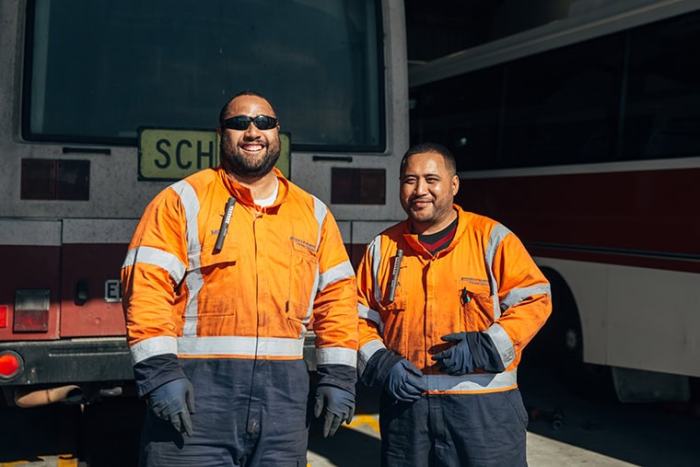
The pair showed up for work experience at Ritchies Murphy Transport Solutions in Takanini during their last term of study at Manukau Institute of Technology. Thanks to their hard work and keen attitude, they made an impression on the workshop manager, Dave Robb (pictured with Kamosi and Puna above).

“I brought in half a dozen students for an introduction to a real engineering worksite,” says Dave, who manages four apprentices and 12 senior staff in the workshop and panel shop, maintaining and repairing a fleet of 160 buses and 40 cars.

“Some of the students were a bit cocky and some didn’t seem interested. But these two were writing things down and really taking notice,” says Dave.

“It’s about attitude in this game — you don’t have to know anything, you just have to be really keen to learn.”

Putting yourself forward

Fronting up to an employer is really worth doing, even if you feel scared or whakamā (shy).

“Just knock on the door and offer to sweep the floor,” says Dave. “Work experience gives you an idea of what you want to do and gives you the inside running when a job comes up.”

Although they were lucky enough to meet Dave through the course, Puna says approaching employers for work experience takes courage, “especially if you’re a bit shy like me!”. But putting yourself out there shows the employer you’ll be willing to put in effort on the job.

And once you’re in the door, you can show your enthusiasm by keeping busy, says Kamosi.

“Work experience is your chance to get on board and show you’re keen.”

“You can never stand there with your hands in your pockets. You’ve got to always be watching the tools and the ways of doing things.”

Getting started

work experience landed Puna an apprenticeship

Puna, 29, grew up with a love for cars — fixing and modifying them in the family garage in Mangere. The Taruia family whakapapa to Niue on his mother’s side and Cook Islands on his father’s. Puna has a sister, and two brothers who are qualified tradies.

He’d been working for seven years as a process worker in a food industry factory and, with his family’s support, he decided to “step up to better things and get qualified”. He started with a NZ Certificate in Automotive Engineering (Level 3) at MIT with help from an MPTT scholarship, which is how he met Mosi.

Kamosi is currently doing his apprenticeship in mechanical engineering

Kamosi Finau, 30, is a married father of a 14-year-old son and three girls aged 11, 5 and 2. Mosi was born and raised in Otara and his family come from Tonga, where they usually try to visit every couple of years.

Having been forklift driving and loading trucks at Foodstuffs for 10 years, Kamosi decided to make a change.

“My father-in-law is a mechanic and he was pushing me to think about a career. I didn’t know much about mechanics, but I enrolled at MIT and things just opened up for me.”

A foot in the door

After laying the groundwork with unpaid experience during their last term at MIT, Puna and Mosi applied for paid work experience at Ritchies over the summer holidays.

“We thought we’d give them both a go,” says Dave. “They started off cleaning dirt from the roofs of the buses. And they turned out to be so keen and useful we buddied them up with a mechanic and extended their paid work experience by three weeks.

“Now — and they weren’t expecting this — we’ve just offered them both apprenticeships,” says Dave.

“We were only looking for one apprentice, but they’re both good blokes and they seem to like being here, so we’ve bought them a toolbox each and look forward to having them around.”

work experienceDave says Kamosi (left) and Puna (right) fit in perfectly with a team that works hard and safely, but has a few laughs along the way.

Puna says getting an email from the chief executive, Todd Murphy, was a huge boost.

“It just gave me massive confidence to know I’m in a job with a future, getting great training and learning work practices from the old boys.”

Dave says he’s always keen to meet enthusiastic learners, and encourages trainees to introduce themselves to potential employers.

“I might be a bit old-school and my approach takes a bit of courage, but I reckon if you front up and knock on the door of a place you want to work, you’ll nearly always get listened to.

“People can see your character when you look them in the eye. It’s a whole lot more effective than sitting behind a computer and answering a whole lot of ads. It gets your foot in the door.”

Work experience helps you get your foot in the door and learn heaps about your trade – and many employers won’t hire you without it. Find out more about how to get work experience.


Make your mark

Work experience is essential for building your skills and adds valuable trades experience to your CV. In fact, a lot of employers won’t hire someone who hasn’t done work experience. Check out these tips on how to land this work and make a good impression on your boss.

  • It’s normal to be scared to talk to an employer, but knocking on their door is well worth the effort. It shows initiative and a positive attitude, which is exactly what employers are looking for.
  • To help you feel more confident approaching an employer, do a bit of research by checking out the company’s website and talk to your navigator for advice.
  • When you show up for work experience, bring a small notepad and pen and take notes on what your boss says. This shows you’re keen to be there and will help you remember what you learn.
  • Ask questions. This shows you’re paying attention and want to learn more. Remember, employers don’t expect you to know much when you’re starting out. Instead, they’re looking for enthusiastic workers who value the chance to be there.

Light at the end of the tunnel

George Patterson
Coming to New Zealand for rugby, George Patterson found his passion in something he never expected. Since receiving his MPTT scholarship, he’s become a qualified mechanical engineer and has spent the last 10 months working on Watercare’s $1.2 billion Central Interceptor project, New Zealand’s longest wastewater overflow tunnel. But the journey hasn’t always been easy. Find out how George overcame a fear of asking questions and became an invaluable part of his team.

A career in the trades wasn’t George’s first plan. But after seeing a demand for mechanical engineers, he decided to give it a try.

At the time, rugby was still his priority. But as he learned more about the trade, he began to develop a real passion for it.

With support from his family and an MPTT scholarship, George completed his National Certificate in Welding (Level 3 and Level 4) at Manukau Institute of Technology.

“My mum and dad always encouraged me towards something like this,” says George, who grew up in Suva but is from Levuka, Ovalau Island in Fiji. “They said sport would only take me so far.”

In 2016, George landed an apprenticeship at Abergeldie Complex Infrastructure in Papakura, with help from his MPTT navigator. But life on the work site was more challenging than he’d expected.

Learning to speak up

MPTT graduate George Patterson with his boss, Ian Norton
George (left) rose to the challenge of his apprenticeship with help from his boss Ian ‘Nod’ Norton, who he now calls his ‘working dad’.

George’s apprenticeship journey was a bumpy road. Not everything made sense at first, and just learning the basics – like the different types of pumps and motors and their purposes – seemed difficult.

“To be honest, it was nothing like what I expected. I knew nothing! I was so fresh in the industry.”

“A lot of kids grow up working on cars and helping their parents out with stuff around home, but I was never a hands-on person when I was growing up.”

At times, George doubted his career choices and his future as a tradie.

“The first two years, I was like, ‘What am I even doing here?’ and ‘Is this the right thing for me?’ I was fighting with myself to stay there.”

But George pushed himself and grew a thicker skin, challenging himself to ask more questions on the job.

“It was hard to put my hand up and say, ‘Can you please explain that and slow it down for me?’ That’s what you have to learn to do though.

“I carried a little notebook in my overalls and wrote things down during the day. Then I’d find my boss Nod at smoko, and ask him to explain things I didn’t understand. He helped me a lot – he was really patient and fair with me.”

‘I never gave up’

As he started gaining knowledge and experience, so too came the respect of his workmates and boss.

“It started to click for me. My boss was putting me on bigger jobs and I’d do them, so he’d give me more jobs. I started to actually do the job because I understood it.”

George’s boss, Ian ‘Nod’ Norton, says George has become an invaluable part of the team since he started working for him in 2016.

“He found it challenging at first, but the great thing with George is that if he doesn’t know something, he asks,” says Nod.

“Then, especially last year, he started picking it up and getting into the nitty gritty. And now he’s the most trustworthy one I’ve got underneath me. We’re like a family here — he’s like a son to me.

“I can leave him with any job now and go away, and I know he’ll do it, or he’ll ask me if he’s confused.”

George currently works for Ghella Abergeldie Joint Venture on the Central Interceptor – a super-sized wastewater tunnel that runs underground from Grey Lynn to the Māngere Wastewater Treatment Plant.

He spends most of his time constructing the tunnel boring machine, and says the experience has solidified a love for his trade.

George is 'fascinated' by the tunnel boring machine he's helping put together and hopes to one day lead a team in building these machines.
George has been using his skills to put together a tunnel boring machine, which will soon help create a super-sized wastewater tunnel. George is ‘fascinated’ by the tunnel boring machine he’s putting together, and hopes to one day lead a team in building these machines.

“There were so many times I could have given up and gone back to Fiji. That would have been the easy option. But I didn’t want to give up.

“I always stayed and pushed on. I knew in my head there was a light at the end of the tunnel – literally, because I was working in a tunnel.

“I always knew it would get better. And it did — I’m happy now. I come home from work smiling.”

Perseverance pays off

MPTT Graduate, George Patterson who completed his apprenticeship while working on Watercare’s $1.2 billion Central Interceptor project, New Zealand’s longest wastewater overflow tunnel.
In the tough times of his apprenticeship, George kept going with encouragement from his family and advice from his grandad that ‘the smooth sea doesn’t make a skilled sailor’.

Last year, the 28-year-old finally completed his apprenticeship and is now a fully qualified mechanical engineer.

“My dad is a man of few words. We had a video call and I brought up my certificate for him to see, and he gave me this big smile. I could see it in his eyes that he was proud.

“And my mum was really proud too. When I told her, she was so happy and said, ‘All your hard work has paid off’.”

Becoming qualified brought a big pay rise — and George knew exactly how he wanted to celebrate.

“As soon as I got qualified and signed the contract, I bought a Ford Ranger ute. I’m six-foot-six, so I’ve always wanted a big ute that I can fit into. I love it and I’m so grateful.”

He says the pay rise has given him heaps more financial security, and he has a few specific money goals.

“I’m young so I’m not really thinking about buying a house yet, but I’m thinking of investing it and making my money grow, and maybe getting a house later.”

George loves his work and has big plans for his future in the trades.

“Every day I go to work, I’m getting new knowledge. I go home thinking, ‘I built that – I did all of that’. So I feel like I own it. I didn’t really have that before. It makes me feel peace inside that I did this job and helped this company.

“In 10 years, I’d love to be one of the leading mechanical engineers on a tunnel boring machine build. And later on, I’d like to be a mechanical superintendent, which means I’d be running a team of engineers. That’s what my boss Nod does now.”

George encourages future tradies to ask lots of questions and have the courage to ask for help.

“When things get hard, just ask. I feel like that’s a big thing for Pacific Islanders – we’re shy about asking questions, asking for help, speaking up. But there’s never a dumb question. And if people do laugh at you, just remind yourself you’re learning something. Always remember you’re an apprentice and you’re still learning.”

No trades experience? Here’s how to start

You can start learning about your trade in a classroom – but it’s hands-on experience that really builds your skills. Find out the best way to get some experience under your belt now, and help you land the job you want later.

To become a skilled tradie, you need time on the tools. But when you’re just starting out, how do you get an employer to take you on? Work experience can help you get your foot in the door and learn heaps about your trade – even if you’ve never worked as a tradie before.

What is work experience?

There are two main ways that work experience is different from a regular job, says Doug Leef, former Kaitohutohu Ahumahi (Community Industry Advisor) for MPTT.

  • It’s only for a set amount of time (whatever you agree on with the employer).

“The expectation is not months of unpaid work but one or two days a week as time, study and employer requirements allow,” says Doug, who is also a qualified builder.

  • You usually won’t get paid. That means employers can afford to take a chance on new trainees who don’t have the experience it usually takes to get employed.

“Think of work experience as creating opportunities and discussions that didn’t exist before, and an investment in your future,” says Doug. “For example, the company I did unpaid work experience for gave me an apprenticeship, and 13 years later I owned the company!”

Why do work experience?

It’s essential to get practical experience in your trade, says Doug.

“Work experience is about getting out into the real world and seeing what life is going to be like post-study. It shows potential employers your commitment to your trade.”

Initially you may feel awkward or uncomfortable in a new space with different people, but experience is how you build your skills.

“Think of it as ‘try before you buy’ and remember that once your course finishes, you’re into the real world,” says Doug.

Here are some of the main benefits of work experience if you’re just starting out in your trade:
  • It’ll help you get a foot in the door, because it’s much less risky for an employer to take you on for work experience than to offer you a job contract straight away.

  • You’ll get to use what you’ve learned in the classroom, and you’ll learn heaps about life on the job.

  • You’ll get a trade job to add to your CV.

  • You can ask for a reference, for when you apply for a job later.

  • It’s a lot easier to get a job once you have some experience in your trade.

  • Once the employer gets to know you and sees you’re a hard worker, they might be keen to offer you paid work.

How to find work experience

It’s a good idea to start looking for work experience well before you finish your course.

“It comes down to the individual. But ideally, the earlier you start the better so you’re creating relationships and opportunities that will serve you well at the end of your course,” says Doug.

Try these ideas for finding work experience opportunities:
  • Tell everyone you know that you’re looking for work experience in your trade. You never know who might be able to help, and if an employer knows someone who knows you, they’ll be more likely to take you on.

  • If you know anyone who works in your trade, ask if they or their employer have any work experience opportunities.

  • MPTT has contacts throughout the trades industry, so ask your MPTT Navigator if they know of any work experience opportunities.

  • Try asking an employer directly. Let them know you like their company and would love to offer your skills. If you’re not sure which employers to ask, Doug recommends trying the tradies in your area first. “I alway suggest starting close to home to make life easier.” It takes guts to introduce yourself to an employer, but it shows you’re keen to learn and can really help you stand out. Even if they say ‘no’, they’ll appreciate your confidence and might suggest other employers for you to approach.

No matter how you go about finding work experience, it’s important to plan for that first conversation with your potential boss.

“Take time to research the company by looking at their website and customer reviews,” says Doug. “That will help you make an informed decision before approaching them about work experience.”

He also recommends talking to your MPTT navigator to help you prepare for discussions with an employer. They can let you know what to expect and give you tips on how to make a good impression.

And once you’re on site, remember employers want workers who are keen to learn – so don’t be afraid to speak up if you don’t understand something.

“Most of all, ask questions if you’re unsure and keep yourself safe, because it’s a long road to retirement!”

Buying first home thanks to trades skills

Since long before he began his construction training, Salesi Vi dreamed of owning his own home. But for many years, this seemed out of reach for him and his family. After beginning his trades training and attending a money workshop through MPTT, the father of two and his wife were able to move into their first home just before Christmas.

Salesi Vi had been working in a factory for eight years, but the life he really wanted remained out of reach. 

After getting married, he and his wife Sandalyn, who worked at the airport at the time, hoped to buy a family home. But their incomes and the savings they’d pulled together just weren’t enough.

“We looked at our finances – not quite enough to buy a house,” he says. 

“We knew we’d have kids coming down the line; there’s a lot of spending there. So we set a goal to find a way to improve our income and be able to afford a house. So we decided to go back to school.”

Salesi, now 37, began training as a carpenter with help from an MPTT scholarship, while Sandalyn also changed careers to work in the dental industry. 

“We were looking at our financials and asking: ‘Are we going to be able to afford to pay the mortgage?’ That’s why we went back to school, to get qualifications and get paid more than what we used to.”

Money talks

During his pre-trades training at Te Wānanga o Aotearoa in 2017, Salesi attended a financial capability workshop. This was delivered by Issac Liava’a, a financial mentor who is also MPTT’s Mana Whakahaere Pasifika (Ambassador).

Issac spoke to Salesi and the other trainees about how to manage their money well, in order to be financially stable now and in the future – advice which Salesi applied to help his family save a bigger house deposit.

“One thing we knew was we needed to make sure we didn’t have debt,” says Salesi, who admits it wasn’t always easy to limit his spending. 

“There was a time when I dropped a hint to my wife to say, ‘Hey, I think it’s time for me to get a new car’. But my wife told me that if your car takes you from A to B, that’s good enough. And obviously I’m still driving – there’s nothing wrong with the car. But I thought I needed a new car at that time.”

Opening the door

In 2020, Salesi and Sandalyn celebrated their 10-year wedding anniversary, which seemed like a good time to buy their first home. They set the goal to own their home within that year.

At around the same time, Issac spoke to Salesi about his future plans and saw an opportunity to help him with home ownership.

Issac had been working for the New Zealand Housing Foundation, a not-for-profit organisation that helps lower-income renting households become homeowners. He told Salesi about the Housing Foundation’s development in Mangere, thinking the family would be good candidates for what’s called ‘shared ownership’. 

This is where Salesi and Sandalyn would buy a majority of the property, with the rest of the house temporarily owned by the Housing Foundation – making it much more affordable than if they were to buy 100% of the home straight away. Over time, the family could then buy the Housing Foundation’s share of the home.

The couple decided to buy the home, and with support from Issac, they moved in a few days before Christmas 2020. 

Salesi (left) was welcomed to his new home with flowers from MPTT, which were handed over by Issac Liava’a, MPTT Mana Whakahaere Pasifika.

“Issac really worked hard to make it happen in that time,” says Salesi. “The kids were very happy – and we were all happy to be in our new home before Christmas.”

By purchasing their home through Housing Foundation’s shared ownership programme, Salesi and his family were able to move into a brand new, three-bedroom home without the need for a large deposit (a minimum of a $10,000 deposit was required – much lower than the usual 20% deposit that’s needed, which in Auckland could be more than $100,000). 

Salesi had previously been considering buying a two-bedroom home. But through the Housing Foundation programme, they were able to purchase a three-bedroom home for less than the valuation price, allowing his two children to have a room each. 

As part of the process, Salesi received support from mortgage managers and solicitors, and will have ongoing support to guide him and his wife through the process of buying the rest of the home from Housing Foundation when they’re ready to. This makes the property more affordable and means they can enjoy living in their home right now.

Could you qualify for help from the New Zealand Housing Foundation? Find out more on their website or get in touch with Issac Liava’a (issac@fcandeconsult.co.nz) to talk about your options.

Salesi’s decision to retrain in the trades has improved his earning potential and helped him and his wife to buy their own home in Auckland.

Want to be better with money? Even if you haven’t been a great saver in the past, money management is a skill you can learn. Find out more about how to make your money last, and get tips to help you make good choices with money. If you’d like to hear about upcoming money workshops through MPTT, get your name on the list by emailing issac@fcandeconsult.co.nz with the subject line ‘Money workshop’.